

GET - Section 4: Implementation Monitoring and Project Adjustments
Overview
Throughout the year, operations engage in implementation monitoring to track the progress of projects and enable action to address issues as they arise. Due to the dynamic nature of the environment, the risk landscape, monitoring findings, donor contributions, and feedback from forcibly displaced and stateless people, funded partners and commercial vendors may need to reprioritize needs, specifications, and resources. This may require amending agreements and contracts during the implementation process.
In a nutshell
- Operations regularly track and verify the progress of projects implemented by funded partners and directly by UNHCR, ensuring compliance with plans and feedback from affected communities.
- They conduct risk-based implementation monitoring to uphold accountability and effective resource utilization.
- They monitor and verify results and financial reports, ensuring alignment with ethical and operational standards, as well as reporting requirements as indicated in the project workplan
- They facilitate project adjustments when required, addressing changes in needs, budgets, or unforeseen circumstances.
- They leverage monitoring findings and community feedback to inform project adjustments and strengthen partnerships.
Implementation monitoring is what UNHCR does to understand progress in the implementation of projects undertaken by funded partners and by UNHCR when under direct implementation (DI).
Implementation monitoring involves:
- Monitoring the progress of projects through site visits (conducted with community members where feasible), desk reviews and ongoing consultations with affected community members, funded partners, vendors and other service providers. Funded partners also submit regular financial reports and updates on progress towards indicator targets.
- Assessing the availability and quality of services and/or delivered goods by collecting feedback from forcibly displaced and stateless people through participatory consultations, feedback and response mechanisms, site visits including together with community members, post-distribution monitoring activities or sectorial monitoring systems (e.g., the Integrated Refugee Health Information System).
- Analysing financial trends against the required and available budget. These include the needs-based budget [the operations plan (OP) requirements], the operating level (OL), forecasted operation expenditure, earmarked funds and possible changes in the OL.
- Verifying the progress of funded partners by conducting performance and financial verifications based on the partners’ project financial reports (PFR) and reported progress against indicator targets.
- Monitoring the compliance of funded partners through the above verifications and risk-based project audits.
- Monitoring the compliance of vendors with their contractual obligations.
Planning of implementation monitoring takes place during annual implementation planning and throughout the implementation year as needed. To ensure effective implementation monitoring, each operation has:
- Plans for implementation monitoring of the most high-risk projects, which are documented in the operation’s assessment, monitoring and evaluation workplan. For more information on this workplan see PLAN – Section 6 and GET – Section 1.
- Clearly defined roles, responsibilities and frequencies for implementation monitoring activities.
- Simple tools and checklists that are agreed upon and used across the operation for implementation monitoring.
- A clear procedure for how implementation monitoring findings are analysed, reported on and used.
- A regular review of the implementation monitoring approach to ensure that it meets the needs of the operation.
To prepare for implementation monitoring, the multi-functional team (MFT) reviews pertinent project background documents such as:
- The project workplan and partner reports, or the vendor contract and progress reports, which set out the expected progress that needs to be monitored.
- Any outstanding issues in the field module in Aconex (the PROMS platform), emails, or other communications where partners, vendors or UNHCR raised recommendations regarding project implementation.
- Feedback about the project from affected communities provided through the feedback and complaints system or reports from previous implementation monitoring visits.
The principles of implementation monitoring are as follows:
- Monitoring activities are undertaken jointly with a funded partner and community members, if feasible and appropriate, to ensure joint buy-in for findings.
- The frequency and approach to the monitoring, as well as whether it is remote or on-site, is informed by the risk assessment and operational context.
- Monitoring activities are guided by an approach inclusive of age, gender and other diversity characteristics that ensures the views from different groups of people are represented, paying special attention to older persons, persons with disabilities, pregnant and lactating women, adolescent girls and persons with health conditions.
- Monitoring activities focus on what information and evidence are needed to enable decision-making and adjustments throughout the year.
💡 KEEP IN MIND High-risk projects include those that have high costs relative to the operation’s operating level (OL), those with partners determined as high-risk during their risk assessment, projects of high strategic importance to the operation and cases where the monitoring of the project is already identified as a risk treatment in the operation’s Enterprise Risk Management (ERM) risk register. |
Implementation monitoring activities may include:
- Direct observation using checklists to assess progress, quality, or compliance with standards.
- Key informant interviews, focus group discussions, or other qualitative assessment approaches.
- Remote approaches such as virtual site visits via video calls or using sensors to measure water flow to a borehole. For more information on remote monitoring see GET – Section 3.
- Review of distribution plans, on-site monitoring and post-distribution monitoring reports, training feedback, and other evidence of goods and service delivery.
- Maintaining, reviewing, acting upon and responding to information coming from feedback and response mechanisms.
- Operaitons use of the “Field” module in Aconex (the PROMS platform) to raise any recommendations or appreciations with a partner, and to identify and act on any recommendations raised by them.
- Regular review of UNHCR corporate reports on budgets, expenditures (for both projects implemented through funded partners and those implemented directly through vendors), and dashboards.
Monitoring cash-based interventions and non-food item programmes
The monitoring of cash-based interventions (CBI) and non-food item (NFI) programmes typically includes on-site and post-distribution monitoring. In addition, CBI programmes include the monitoring of financial transactions and the risk monitoring of financial service providers (FSPs). CBI and NFI monitoring provide valuable insight into the progress of the projects and are key to providing assurance to internal and external stakeholders.
On-site monitoring visits
On-site monitoring during distribution is important for CBI and NFI programmes when UNHCR implements directly or when these programmes are delivered by a funded partner.
During on-site monitoring visits, UNHCR ensures that individuals receive their CBI/NFI entitlements and that distributions are conducted respectfully, allowing individuals to raise concerns, receive responses and be referred to the necessary protection focal point, if applicable.
Special attention is given to services for persons with specific needs, including accessibility and targeted support for various groups such as older persons, persons with disabilities, pregnant and lactating women, adolescent girls, persons with health conditions and persons with other diverse characteristics.
Post-distribution monitoring
Post-distribution monitoring is conducted after the distribution of cash or NFIs to assess distribution quality, utilization of assistance, coping strategies, and spending habits. Its purpose is to verify compliance, detect irregularities, and inform improvements in the design, targeting, calculation and delivery of CBIs and NFIs.
Post-distribution monitoring for CBI and NFI programmes is distinct from distribution exercises. It is typically conducted within four weeks of the distribution, although timing may vary based on the specific objectives.
Post-distribution monitoring requires inputs from the entire MFT. The opportunity to coordinate data collection with other actors is always explored when planning the monitoring exercise. UNHCR data protection principles are followed, ensuring that the collection, analysis, sharing, and retention of personal data are proportionate, legally justified, and respect the rights of data subjects. While UNHCR or a third party may implement the monitoring, the partner responsible for the distribution under review should not conduct it to avoid conflicts of interest.
Cash-based interventions
The post-distribution monitoring of CBIs is mandatory. It is conducted at least once a year in line with the CBI tools and guidance.
Non-food items
The Non-Food Item Management guidance provides information on the post-distribution monitoring exercise for NFI distributions. It includes sample questions to be considered for household visits and focus group discussions.
The monitoring of funded partner projects ensures the effective management of the partnership and the progress toward the operation’s planned results. A partner monitors their activities and reports on their performance and expenditure to UNHCR, which then verifies the partner’s reports by reviewing all information available. This verification aims to assess whether activities are progressing in accordance with the desired deadlines to the standard of quality required and whether resources are being used for the intended purposes.
In addition to monitoring performance and expenditure, UNHCR ensures that a funded partner complies with the terms, responsibilities, and provisions of the project workplan, as well as with humanitarian and ethical standards. Compliance is assessed through external project audits, the UN Partner Portal (UNPP) partner capacity and risk profile, and/or internal control assessments led by the project control function. Substantive concerns regarding the partner’s compliance are shared with other UN organizations through the UNPP’s “flag” system. These monitoring approaches enable UNHCR to effectively manage its partnerships and ensure that partners meet their obligations.
Partner indicator reporting
To monitor performance during the implementation year, a funded partner reports to UNHCR on the agreed indicators in the results plan, in accordance with the indicator reporting frequency and through the data collection system or tool stipulated in the project workplan. In many operations, funded and non-funded partners report via ActivityInfo. Operations may also use other tools/systems, including Aconex (the PROMS platform), to share a reporting template with a funded partner.
Once a partner reports on its indicators, the results manager checks the actual performance against the reported indicator values, to validate what was reported. Where a funded partner is collecting primary data (e.g., as part of post-distribution monitoring), an operation may recommend the use of KoBo, which is UNHCR’s corporate digital data collection tool. However, KoBo should not be utilized for personal data collection because such data can only be collected using proGres, the UNHCR Registration and Case Management system.
Changes to indicator targets for existing outputs and indicators, which may occur throughout implementation, are confirmed through the partner’s reporting on actuals in agreement with UNHCR. These changes alone do not constitute a project workplan amendment and therefore, do not require a results plan amendment in Aconex (the PROMS platform). When no other changes are needed, adjustments to planned targets can be documented via email for audit purposes. The negotiated indicator targets in a results plan are indicative and are not included in the project workplan contract. The emphasis remains on providing evidence-based results. See GET – Section 2.
It is understood that these changes will not be reflected in COMPASS or the results plan unless an amendment to the project workplan necessitates a change in scope within COMPASS. In such cases, the targets can then be amended accordingly.
Partner implementation challenges
UNHCR and partners jointly monitor implementation, documenting challenges and raising recommendations. While an annual end-narrative report is required from funded partners, the emphasis during implementation is on continuous monitoring and follow-up actions. This continuous monitoring takes many forms, which can either be led by the partner or coordinated by UNHCR. UNHCR and partners communicate challenges and follow up on recommendations during on-site visits, performance and financial verifications, and assessments. For implementation challenges identified, risk mitigation measures may be required, prompting the potential need to update the project workplan risk register to incorporate the new risk(s) and treatment plan(s). Alternatively, the implementation challenge may be linked to an existing risk, with its treatment plan already reflected in the risk register.
🤝 SOFTWARE TIP: ACONEX During implementation monitoring, UNHCR or a partner (as an initiator) can raise a recommendation or an appreciation using “Issues” in the “Field” module by selecting the “Issue” type “Implementation Monitoring”. Click here for more details and here for the workaround process. For further information, see guidance on Field Issues and video tutorials. |
Partner financial reporting
The project financial report (PFR) requires a partner to periodically report on project expenditures and has a standardized format. The report shows the total funds that UNHCR has disbursed to the partner and variances in expenditure against the financial plan. It also provides a useful indication of the rate of expenditure and alerts UNHCR of unplanned or unacceptable variations that have occurred.
A partner submits the PFR for UNHCR verification in accordance with the project workplan stipulations, with a minimum of three partner PFRs submitted annually (mid-year, interim and year-end). If the project start date is after 1 January, fewer PFRs may be required. Financial reports may be submitted by the partner outside of the scheduled reporting frequency (unscheduled PFR) when the next prepayment is required. The PFR is shared by the partner via Aconex (the PROMS platform). This allows for timely verification and the reflection of approved expenditures in Cloud ERP, so that UNHCR’s financial expenditure is globally projected efficiently. See an Example of a Project Financial Report (EN, ES, FR).
The partner’s indirect support costs are automated and reported in the PFR submitted by the partner. In the PFR template, these costs are pre-set at the relevant percentage values of outputs from the final agreed total financial plan. The grand total of the partner’s indirect support costs reflects the correct percentage of the total reported actuals in the PFR template.
The interim PFR is a critical report at the operational and global levels. The operation decides on the deadline and reporting period covered by the interim PFR before signing the project workplan, however, it must cover expenses in the last quarter. The interim PFR is submitted by a partner at the latest by 10 December, as agreed upon between the operation and the partner, and it covers expenditures before that submission deadline. The interim PFR helps UNHCR assess what commitments it can absorb, allows for financial reporting to donors, and indicates if the budget may need to be revised for the following year.
It is essential that the partner and UNHCR track currency and exchange rate fluctuations and communicate on important changes with a potential negative impact to achieving agreed results, as well as appropriate mitigation measures.
For additional clarifications, lessons learnt and tips to facilitate the processing of Project Financial Reports (PFRs) in Aconex (the PROMS platform) and Cloud ERP.
Partners reporting on revenue
Any interest gained by a partner directly due to a UNHCR-funded agreement can be used by the partner for activities that are consistent with the goals of the partnership and will be documented in accordance with the partner’s financial rules. However, if the partner’s financial rules necessitate the return of the interest income, it will be repaid to UNHCR and reported via the relevant supporting documentation, when submitting the PFR. This amount is not to be reported as expenses within the PFR and is not subject to a UNHCR financial verification. The supporting documentation may comprise the following:
- For a separate account, the partner provides a copy of the bank statement where the interest income received is indicated, uploading it as a supplementary file to the PROMS PFR workflow upon submission; or
- For a pooled bank account, the partner provides a schedule document showing their calculation for the apportioned interest income due to UNHCR, uploading it as a supplementary file to the PROMS PFR workflow upon submission.
Non-interest revenue received by the partner directly due to a UNHCR-funded agreement is reported by the partner with the next PFR after the revenue is received via the relevant supporting documentation as described above. This includes insurance revenue resulting from project-related insurance claims, income-generating activities and value-added tax (VAT). Non-interest revenue is not to be reported as expenses within the PFR and is not subject to a financial verification by UNHCR. The representative or director has the authority to approve if such non-interest revenue will be used by the partner for activities that are consistent with the goals of the partnership, or if the amount will be refunded to UNHCR. All such decisions are documented for audit purposes in the operation’s SharePoint folder.
Partners reporting on expenditure incurred in a different currency
The partner reports in the currency of the financial plan. The partner may legitimately incur costs for a project output that are not in the same currency as noted in the financial plan. In these circumstances, determining how to report expenses in the currency of the financial plan, as required within the PFR, depends on whether the partner has a dedicated bank account for UNHCR funds, or whether it uses a pooled bank account (as confirmed in the partnership framework agreement cover sheet) in which UNHCR’s funds are mixed with funds from other sources, as follows:
- Dedicated bank account: Expenses are converted based on the withdrawal/payment date and the exchange rate of the bank.
- Pooled bank account: Partners follow their internal rules for expense recognition and document the applied exchange rates.
Some partners may utilize both a dedicated and a pooled bank account. An example may be when an INGO uses a dedicated bank account for project funds and a pooled bank account for personnel costs. This is known at the time of signing the PFA. In this situation, the partner must have shared their relevant policy on exchange rate treatment for such pooled expenses with the UNHCR operation. The UNHCR operation checks this policy while verifying this type of expenditure that is affected by the exchange rate.
🤝 SOFTWARE TIP: ACONEX The PFR process utilizes the “Document” and “Workflow” modules in Aconex. Click here for more details and here for the workaround process. |
Partner personnel reporting
The partner’s personnel are remunerated in accordance with the partner’s human resources policies, systems and procedures. UNHCR does not require partner personnel lists to be annexed to project workplans, nor does it have a global standardized contribution cap or limit for partner personnel costs. However, partner personnel costs remain a key focus area of implementation monitoring. The partner does not charge more staff costs to a UNHCR-funded project than the amount defined in the partner’s human resources policies and employment contract. If a partner reports to UNHCR that it has made excessive payments to a staff member from UNHCR project funds, the excess amount is classified as an ineligible expense. Additionally, the partner is prohibited from coercing employees into providing any portion of their net salary and reporting it to UNHCR as an expenditure within personnel costs. Finally, all expenses claimed in the PFRs are those fully funded by UNHCR and cannot be reclaimed again to another donor for double funding. Such actions constitute attempted fraud and a breach of the agreement and may give rise to termination due to misconduct..
The operation can request a partner to provide a breakdown of partner personnel charged to the project with each PFR in case the risk assessment during the development of the project workplan recommends this as an essential control measure. A partner personnel reporting template can be provided by UNHCR, or preferably generated from the partner’s human resources system. See the Sample Partner Personnel List.
Reporting on UN-to-UN agreements
The UN agency PFRs are submitted and approved in Aconex (the PROMS platform). Other reports, including narratives, are submitted by UN partners as agreed and stipulated in the agreement. Taking into account that UN organizations are subject to the UN single audit principle unless agreed specifically with the concerned UN organization, the financial verification of UN partner Project Financial Reports (PFRs) is not required, therefore no project financial verification (PMC03) needs to be completed. However, joint performance monitoring is highly encouraged and therefore a project performance verification can be conducted by completing the PMC02 form in Aconex (See the software tip on the PMC02 process below).
Verification ensures accurate reporting of performance and expenditures by partners. UNHCR conducts project performance and financial verifications before accepting the Project Financial Report (PFR) and releasing further funds. The verification confirms that the reported expenditure and the use of resources are sufficiently supported by evidence to prove that outcomes or outputs are being met and delivered in accordance with the set targets and indicators.
The frequency and number of verifications are determined by the number of PFRs indicated in the project workplan contract. See GET – Section 2.
The key elements to be verified are the following:
a. The reported progress against outputs corresponds to agreed results and activities and is based on the output indicators as stipulated in the results plan of the project workplan.
b. The reported results and activities achieved (e.g., the number of latrines built, the number of persons assisted with civil status registration or documentation, etc.) are actually in place.
c. The reported expenditures and financial information are accurate and in accordance with the financial plan.
d. The reported expenditures reconcile with the delivered outputs. For example, the percentage of the delivered results of an output relates to the percentage of the expenditures of this output.
e. The inputs and resources (financial, human and other) are justified in terms of the activities performed and the outputs are delivered in a cost-effective manner.
f. The resources are used for the purposes intended.
g. The reported expenditures are reconciled with the partner’s accounts and general ledgers.
h. The partner has reliable and effective internal financial and budgetary control mechanisms to prevent fraud and the misuse of resources.
If, during a financial or performance verification, significant flags warrant reporting the partner to the Inspector General’s Office (IGO), key elements of the issues raised are to be confidentially discussed during the next scheduled external project audit to inform the audit risk assessments and to ensure the issues are covered.
Project performance verification
The project performance verification process may be initiated at any time within the project workplan duration. However, given the mandatory requirement ahead of any next prepayment, it is good practice to commence a project performance verification during the month an operation expects to receive the partner’s PFR. There is no need to await the PFR from a partner to initiate the performance verification.
The project performance verification is completed by programme personnel using the project performance verification template (PMC02) in Aconex. Programme conducts a desk review, looking at the validated indicator data reported by the partner, monitoring and feedback from communities and a snapshot of the partner’s challenges, recommendations and/or appreciations in Aconex (the PROMS platform), raised by UNHCR and/or the partner. See the software tip on Field Issues above.
💡 KEEP IN MIND Project performance verification includes ongoing monitoring and direct feedback from communities or identified population groups engaged in project activities. This feedback is documented in the project performance verification (PMC02) under the “protection and solutions” challenges category and is essential for informing any necessary project adjustments. If significant changes are required, a formal amendment may be initiated, ensuring responsiveness and that the partner and/or UNHCR communicate these changes back to the community. |
Programme personnel upload a copy of the partner’s reported indicator data (e.g., an extract from ActivityInfo or an Excel table) within the project performance verification (PMC02) in Aconex.
The validation of indicator values, carried out by the results manager, is critical also for financial verification when the expenditure rate is considered against the overall progress of results achieved. Comments and justification for the implementation rate could be provided in the PMC02 form. See the PMC02 Guidance and Example (EN, FR, ES).
🤝 SOFTWARE TIP: ACONEX The project performance verification utilizes the “Field” module in Aconex. Click here for more details and here for the workaround process. |
Monitoring the Project Risk Register
Throughout project implementation, UNHCR and its partners jointly monitor the risks and the statuses of their respective treatment plans in the project workplan risk register. For partners processing personal data, the risk register may include data protection and/or information security risks. Due to shifts in the contextual and operational landscape, there may be a need to add new or modify existing risks in the register. Furthermore, the treatment plans are actioned throughout the implementation year, with adherence to their target deadlines, and thus the register is updated to reflect the changing statuses of these plans (i.e., from “not in place” to “work in progress” to “in place”).
The risk register is a live tool to be utilized jointly by UNHCR and its partners to acknowledge potential project-specific challenges and proactively deal with them.
🤝 SOFTWARE TIP: ACONEX The risk register process utilizes the “Document” and “Workflow” modules in Aconex. Click here for more details and here for the workaround process. |
💡 KEEP IN MIND Throughout the PFA's duration, some risks may continue from year to year and could be carried forward. Operations may upload the risk register from the last project workplan as a new document in Aconex, registering it under the new project workplan contract ID number and reviewing/updating it to ensure new or evolving risks are identified and continuing ones properly managed. This process is repeated for each subsequent workplan, using the risk register from the previous project workplan as the baseline. This approach ensures continuity in risk assessment and facilitates timely risk management adjustments through the PFA. |
Project financial verification
The project financial verification is led by the project control function in collaboration with the MFT, including results managers. The financial supporting documents are reviewed on-site or remotely with the partner to verify the reported expenses.
There are two types of project financial verifications with corresponding templates – the PMC03 long and PMC03 short forms. The PMC03 long form is the standard tool that is used for any scheduled project financial verifications. The PMC03 short form is not an in-depth financial verification and therefore may only be used in some cases and only for partners with a low-risk rating – either for their interim project financial verification or when they submit an unplanned PFR (i.e., not included in the project workplan reporting schedule and submitted, for example, one month after a previously verified scheduled PFR). A prepayment will still be released upon successful approval of a PFR where the PMC03 short form was used for the financial verification.
The PMC03 short form does not involve the verification of transactions, inspection of supporting documents, or review of pending verification recommendations. Therefore, the expenditures related to this “short” process are included within the partner’s requested transaction list for sampling by project control, when it is time to conduct the next scheduled “long” project financial verification. During this next scheduled verification, any ineligible expenditures revealed from the previous PMC03 short-form process will be deducted from the expenditures reported in the PFR for the PMC03 long-form process. Comments can be added by project control in the PFR template to explain this deduction.
The monitoring of expenditure in relation to the rate of project implementation is a key aspect of ensuring that the project is under proper financial control. The project financial verification of each partner’s PFR completed by UNHCR is critical and the project control function needs to approve it before UNHCR releases the next prepayment of funds.
In situations with serious constraints, the operation considers remote standard financial verification for the PMC03 long form. The remote review of a PFR may be deemed appropriate when on-site verifications cannot take place. However, when the project financial verification is conducted remotely, the justification is documented in the PMC03 long form. The PMC03 short form can be completed remotely, regardless of the operational constraints. See GET – Section 3 for more information on remote monitoring.
See the PMC03 Guidance and Example (EN, FR, ES).
Eligible expenditure
When a partner reports on eligible expenditure, it includes all expenditure lines, wholly and solely funded by UNHCR that are charged to a project as a direct programme and/or shared costs, for activities implemented within the approved project period and commitments liquidated by the allowed project liquidation period.
The partner is not required to report on the expenditures for their indirect support costs and, accordingly, UNHCR does not verify these costs. However, the partner is advised to retain detailed information supporting such expenses, as UNHCR reserves the right to conduct exceptional checks to obtain assurance when required (e.g., during an IGO investigation). See GET – Section 2 for more information on partner indirect support costs.
In some situations of specific complaints questioning the validity of results achieved and/or the eligibility of expenditures, the bureau and the concerned operation, in collaboration with the Inspector General’s Office (IGO) and headquarters, may be required to undertake specific performance and/or financial verification reviews to obtain assurance that such complaints do not affect the results reported.
🤝 SOFTWARE TIP: ACONEX The project financial verification utilizes the “Field” module in Aconex. Click here for more details and here for the workaround process. |
Release of partner’s prepayment
When a partner requests a follow-on prepayment, UNHCR considers the unused balance from the prior prepayment, project progress, and any forecasted non-linear expenditures for the upcoming period. In accordance with the Guidance Note on UNHCR Funded Partnership Management, if the unused balance from the previous prepayment is more than 1/6 of the total amended financial plan, a new prepayment is not recommended.
The Financial Plan Amendment template should not generally be used to facilitate the next prepayment, as prepayments are only released after a Project Financial Report (PFR) has been submitted, and the performance (PMC02) and financial (PMC03) verifications have been satisfactorily completed. The approved value for the next prepayment is recorded in the PFR template, and approval of the PFR in Aconex triggers the automatic creation of the prepayment invoice in Cloud ERP through system integration.
Unspent balances
If unspent balances from the prior year remain unrecovered, the partner will be informed in writing that the remaining balance will be used for the implementation of activities of the new project workplan. The operation will deduct the unspent balance from the next prepayment through a manual calculation, inserting the reduced amount within the PFR template’s prepayment table. The partner must report expenditure against both the reduced prepayment (new UNHCR funds) and the deducted amount (the partner’s retained unspent balance).
Prepayment determination
Prepayment amounts are determined based on the project’s performance (as reflected in relevant verifications) and are aligned with the planned work for the next period, as outlined in the project workplan.
Project workplan amendments post-verification
When a project workplan amendment occurs shortly after a satisfactory performance and financial verification, a Financial Plan Amendment may be used to authorize an additional (“top-up”) prepayment within six weeks of the last approved PFR. For example:
- A PFR is approved, with on-track progress and satisfactory financial verification. The next prepayment (e.g., #2) is released.
- A budget increase and/or new outcome/output is agreed, necessitating an amendment and an additional prepayment (e.g., #3). This unscheduled prepayment should be included in the Financial Plan Amendment and noted in the “UNHCR comments” column, indicating that no new verification is required, as it is linked to the prior performance and financial verifications.
Exceptional circumstances
In exceptional cases, such as emergencies requiring an urgent response, an immediate prepayment may be needed before recent performance and financial expenditures are verified.
In these situations, the project workplan signatory (e.g., the representative or delegated authority) must provide a signed justification for releasing the prepayment. This justification is attached as supporting documentation to one of the following:
- A PFR workflow, alongside an empty PFR with zero expenditure recorded and the prepayment inserted; or
- A Financial Plan Negotiation workflow, alongside a Financial Plan Amendment with the prepayment inserted.
For other exceptions beyond the above scenarios, country operations are advised to consult their respective bureau before releasing any prepayments through the use of a Financial Plan Amendment.
Feedback to the partner
UNHCR shares with the partner the findings of all verifications, such as implementation rates, compliance with internal controls, implementation challenges and delays, or deviation from the planned activities and resources through regular communications and any relevant recommendations/appreciations raised via “Field Issues” in Aconex. Prior to approving the partner’s reported expenditure in the PFR, sharing the PMC02 and PMC03 with the partner for their review is a key element of maintaining transparency for the partnership. In addition, obtaining the partner’s acceptance of the PMC02 and PMC03 is considered a good practice. Findings are used to improve project implementation, identify corrective actions or adjustments, optimize the use of resources, revise plans to achieve desired results in response to the operating environment, and support the partner to strengthen their capacity.
The conclusions of the verifications inform any adjustments to the project budget, activities and targets. Moreover, the information generated by monitoring serves as input into the MFT’s deliberations on potential shifts in programming, including budgetary reallocations. It is recommended that the operation facilitates an open channel of communication surrounding the recommendations and allows the partner to regularly provide feedback on progress made.
Assets
The programme function coordinates a physical verification exercise of assets under the ownership and control of UNHCR (i.e., those that appear on UNHCR’s asset list in Cloud ERP), provided to partners through the right-of-use clauses in the project workplan, on an annual basis. Partners are required to facilitate the visit of assets and to cooperate with UNHCR or other duly authorized persons.
Goods and property bought and controlled by a partner under a project workplan are recognized as a partner expense when the partner acquires the relevant goods. Therefore, goods and property bought by a partner with UNHCR funds are not required to be reported on or verified by UNHCR. Similarly, assets previously controlled and owned by UNHCR that are transferred to the partner are also not required to be reported on, nor verified. In both cases, the partner is responsible for the proper disposal of the asset at the end of its useful life.
The UNHCR Fixed Asset (FA) Report can be generated and exported from Cloud ERP in which the programme function will indicate any changes required from the annual physical verification. This FA report lists UNHCR assets provided via the right-of-use clauses and is uploaded in Cloud ERP by the asset focal point within the operation.
A partner that has vehicles and generators owned and controlled by UNHCR under the right-of-use conditions within the project workplan submits monthly vehicle and generator data (e.g., mileage, fuel, servicing and repair) to UNHCR, which reflects this in FleetWave.
Monitoring and review of the partners’ PSEA Capacity Strengthening Implementation Plan
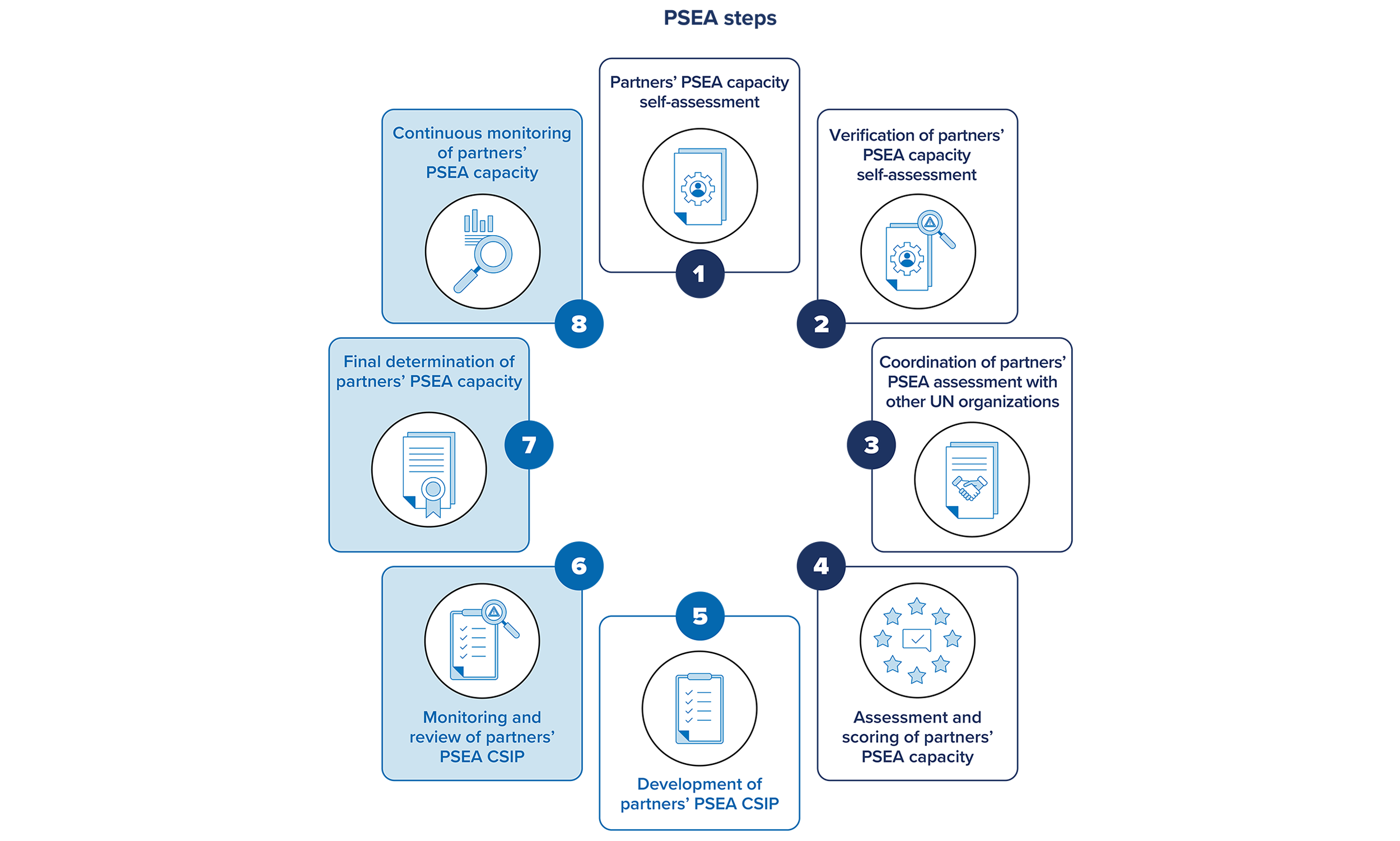
If the partner has a PSEA capacity strengthening implementation plan (CSIP) in place, UNHCR continuously monitors its implementation, so that the partner becomes fully compliant with the eight core standards within the completion dates agreed on and set in the CSIP. UNHCR may add monitoring comments in the UNPP, as applicable. If the partner is unable to complete the CSIP activities within six months, the plan can be extended for an additional three months in the UNPP (nine months in total).
A progress review of the CSIP takes place after six or nine months. UNHCR updates the partner’s implementation of the CSIP activities and uploads supporting documents to the UNPP.
Once all activities are marked as “completed”, the overall score of the partner’s capacity is automatically re-calculated, and the partner’s capacity becomes “full”. See the UNPP PSEA guidance for more details.
🤝 SOFTWARE TIP: ACONEX See further guidance on updating a CSIP in the PSEA Module User Guides and Resource Materials of the UNPP. |
All previous actions taken with regard to the CSIP and the history of ratings, along with the UN organization responsible and the relevant dates, are recorded in snapshots and under the rating history.
In addition, UNHCR uses the project performance verification (PMC02) to monitor measures taken by the partner to strengthen PSEA, including any related risks identified in the project workplan.
If following a CSIP review, which takes place after six or nine months, a partner has not reached full capacity (i.e., remains at medium or low capacity), UNHCR assesses if the project workplan continues until the end of the calendar year or project, considering potential disruption and/or unavailability of services, and documents the decision.
Final determination of a partner’s PSEA capacity
If the partner has not reached full capacity at the end of the six or nine months of the CSIP, their PSEA capacity is rated as medium or low, depending on the completion of CSIP activities. For example, if the partner completes activities for only one core standard out of three in the CSIP, that completed standard is added as one point to the preliminary score. If no CSIP is developed for low- or medium-capacity partners within seven months since the preliminary determination of PSEA capacity, the PSEA module automatically concludes the final determination based on the preliminary score.
The final determination is valid for five years unless any circumstances occur that trigger a re-assessment.
The CSIP will remain available on the UNPP for partners to complete any missing activities. Once UNHCR or another UN organization confirms that a partner completed the remaining activities of the CSIP, the final determination scoring is automatically updated confirming the partner’s full capacity. However, the five-year validity date remains unchanged. If the partner has no access to the UNPP, the operation uses the offline version of the UN Common Tool and CSIP, concludes, signs and shares the final capacity determination with the partner.
SOFTWARE TIP: UNPP See further guidance on updating a CSIP in the PSEA Module User Guides and Resource Materials of the UNPP. |
Continuous monitoring of partners’ PSEA capacity
Even after the final determination of capacity, an early re-assessment may be deemed necessary at any point before the expiration of the five-year validity period. Such circumstances include significant changes in the partner’s PSEA-related capacity based on monitoring findings, major changes in the partner’s organizational structure, new SEA allegations where the partner failed to implement appropriate prevention and response measures, or significant changes in the operational context.
Monitoring and strengthening capacity for grant agreement partners
Operations monitor grant agreement partners against planned activities and follow up as required. Operations document the monitoring findings in the final narrative report. Grant agreement partners are not required to report on their expenditures.
Operations and partners can opt for additional support from project control and MFT members to enhance internal controls. This support could include, for example, guidance on implementation, cash disbursements, cheque authorization, bank reconciliations, purchases, payroll and taxes. Such guidance is not based on UNHCR's grant but is focused on strengthening overall processes.
This optional assistance helps grant agreement partners improve their financial processes and internal controls, enabling their future transition to funded partnership agreements.
Implementation reviews provide evidence for project adjustments and inform priorities for the upcoming year. This may include reprioritizing results and resources, evaluating partnerships, or exploring implementation changes.
It is recommended that operations review and adjust as needed project workplans based on documented feedback within the project performance verification from forcibly displaced and stateless people, at least once per year. UNHCR ensures transparent and timely communication of monitoring and verification findings and recommendations to partners and provides them with the opportunity to comment on the recommendations before a final decision is taken on any project modifications that have implications for the partnership.
Partners are required to report immediately to UNHCR any misconduct allegations against their personnel, including fraud, corruption, sexual exploitation and abuse, etc., as soon as they occur or come to their attention. They can contact UNHCR’s Inspector General’s Office via email ([email protected]) or through the UNHCR website. Any member of the partner can raise concerns with the IGO, and all UNHCR personnel are reminded of their duty to report any instances of misconduct to the IGO. Any other irregularities can be escalated to the respective bureau or headquarters.
Project workplan variations
A variation to a project workplan is slight changes in the agreement that do not require an amendment but need to be documented. The partner and UNHCR may wish to incorporate these changes in the agreement during the next amendment. This may include:
- Changes to the original budget breakdowns from the financial plan, due to reallocations between account codes, expenditure organization and/or existing outputs within the 30% or 50% budget flexibility stipulated in the project workplan, are entered in the PFR template. These variations are reflected in COMPASS.
- Reallocations of direct shared costs and addition of new direct shared cost account lines, while maintaining the same overall budget of the financial plan and respecting the budget flexibility level between outputs (30% or 50%) This does not require an amendment to the project workplan contract in Cloud ERP. These variations are reflected in COMPASS at the output level.
- All administrative details surrounding the partner, including a change in name or bank account, are under the Cloud ERP supplier information. When such a change is required, the partner updates the registration form, which is then reviewed by the operation. The operation enters the change in the partner’s supplier record in Cloud ERP, which is approved by the Master Data Management (MDM) unit in headquarters. See the Guidance on Partner Registration in Cloud ERP for information on how to modify an existing partner’s supplier record.
Project workplan amendments
A project workplan amendment is a more formal process than a variation and is required when there are changes to the project workplan contract. This includes:
- Adding or deducting an output and/or indicator.
- Increasing or decreasing the overall total budget under the financial plan.
- Any modifications to the content of the contract terms (e.g., changing the implementation period start and/or end date, changing the activities, changing the essential controls etc.).
- Modifying the financial plan when surpassing the stipulated budget flexibility at output level (30 or 50%) which can be processed via a “Financial Plan Amendment” or PFR template through reallocation in Aconex.
- Providing a UNHCR asset to a partner under the right-of-use conditions.
When amending an existing project workplan, the operation considers firstly the partnership framework agreement (PFA) scope to ensure that an amendment to the partner’s project workplan is within the overall scope of the PFA in terms of the intended results and/or geographical region(s) for which the partner was selected. If a new ICQ score results in a change in the project’s risk rating, the relevant essential controls applied in the project workplan may be adjusted as an amendment. However, such a decision would need to factor in the remaining period of implementation and the impact on reporting. An amendment to the project workplan has to be consistent with any limitations or conditions identified by the Implementation Programme Management Committee (IPMC) at the time when the partnership selection was endorsed. UNHCR discusses with the partner any concerns surrounding the potential change in the scope of the project or the subsequent impact on the partner’s capacity to deliver the work. If necessary, these concerns are referred to the IPMC and addressed before the signature of the amended project workplan.
⚠️ ALERT No new project workplan may be created and signed after 30 November of each year, except if the operation is in a declared emergency (see GET – Section 5 for more details on agreements in emergencies), and no amendment of an existing project workplan may occur after 15 December of each year. |
Amendments to UN-to-UN agreements
The same process for amending a project workplan also applies to amending a UN-to-UN agreement. The latest approved UN-to-UN agreement is downloaded from Cloud ERP in a Word document, and used in case an amendment is required. See the software tip above.
Project workplan extension
The project workplan implementation period concludes on 31 December, and the liquidation period continues for one month, until 31 January of the following year, or as otherwise specified. During this period, the partner can settle financial commitments made prior to the completion date but cannot undertake new commitments or implement new activities.
There is a significant difference between the types of extension, which may refer to:
- An extension of the liquidation period, which is solely for the settlement of payments for completed activities that were delivered by 31 December.
- An extension of the implementation period, which is authorized by the bureau, and by which activities may be extended beyond the original agreement period (up to 31 December) into the following year.
This distinction is important to keep in mind when an extension request involves earmarked donor contributions with a cut-off date of 31 December.
If circumstances beyond UNHCR’s control require an extension, the partner can submit a request via PROMS before the end of November. The operation evaluates all requests, and the most senior member of programme determines which ones are sent for approval to the bureau (for country operations) and DSPR (for bureau and headquarters). If extension requests are approved, the operation amends the project workplan contract by 31 December in Cloud ERP, at the latest.
The request for an extension is submitted by the partner and considered by the operation if:
- There is an unforeseen natural hazard-induced event (e.g., a hurricane or volcanic eruption).
- There are security issues.
- There are unforeseen events beyond UNHCR’s control that caused delays in the implementation of the project, but commitment to donors for earmarked funds necessitates the completion of the project in a specific period.
- The reason does not fall into the above categories but is a justifiable unforeseen situation beyond the control of the partner and UNHCR, such as unforeseen changes in government/authorities/de-facto authorities resulting in significant changes in interlocutors and/or counterparts, legislation, etc.
Partnership framework agreement (PFA) amendments and terminations
A PFA can be amended if the changes required in the project workplan lead to the addition of another outcome area(s) that falls within the scope of the partner’s selection. In exceptional cases, including during emergencies, where there is a change that goes beyond the original scope of the partner’s selection, a PFA amendment is required. In such cases, the head of sub-office, representative or director can expand the scope of a PFA with an existing partner rather than opening a new call for expression of interest (e.g., to cover a new outcome area or geographical area) without a new recommendation from the IPMC, if the partner has prior experience, proven capacity and is willing to expand. The exceptional circumstances are documented, signed by the representative or director and saved in the operation’s local SharePoint.
Termination is extremely rare, given the potential impact on the other party but most importantly on the people benefiting from the activities and services of the agreement. This process should be conducted carefully, with the causes and all steps documented for audit purposes in the operation’s SharePoint.
The termination of a project workplan, together with the relevant PFA and DPA, prior to the end of its planned period is the cessation of planned activities within the implementation year. This is unlike an ordinary project closure or a PFA and DPA amendment to an earlier end date for the coming implementation year.
Both UNHCR and the partner have the right to terminate a project workplan, and related PFA and DPA, for any reason and at any time by providing a number of days’ written notice to the other party. The partnership terms of the agreement specify the number of days’ notice required depending on the reason for termination. Obligations following termination or expiry are also listed. Written notification may be communicated to a partner via PROMS. UNHCR operations may terminate an agreement with cause, with immediate effect.
UNHCR and the partner should jointly develop an action plan for winding down the agreement, including the safe handover of responsibilities, documents and files, personal data, and assets. In the event of a project workplan termination, it is important that an operation aims to minimize the negative impact on affected communities during the termination process.
The representative or director has the authority to terminate agreements. When terminating an agreement according to Scenario 3 below, the bureau, and headquarters are consulted and clear any related official communication to the partner.
The following comparative scenarios guide decision-making regarding amendment and termination of agreements:
Scenario 1: Reprioritization with partnership continuity: Operations reprioritize results or reallocate resources, potentially delaying project workplan negotiations until later in the following year(s).
Scenario 2: Partner performance-related challenges: The partner demonstrates underperformance that impacts project results or the viability of the partnership but does not constitute a breach of the partnership terms warranting termination.
Scenario 3: Partner’s non-compliance, ethical, operational breaches, or contextual constraints:
a. The partner exhibited significant issues such as breaches in compliance, ethics, mandate-related changes, or other factors impacting UNHCR's credibility or operations.
b. The partnership faces challenges "for convenience" when external factors, such as changes in government regulations or restrictions make it impossible to continue the engagement.
Flagging a partner in the UNPP
The UN organizations that participate in the UN Partner Portal (UNPP) have a procedure for raising different “flags” on partner profiles. If UNHCR establishes that a partner has failed to meet important obligations under a project workplan, PFA and/or a DPA, such as those related to financial matters, PSEA, ethics, integrity and investigations, or data protection standards, then UNHCR “raises a flag” on the partner’s profile in the portal.
The following flagging categories are available:
- Performance/delivery issues
- Management/administrative issues
- Confirmed fraud or corruption
- Safeguarding violation
- Other
Suspension or barring of a partner
A partner may be suspended or barred from partnering with UNHCR at the country, regional and/or global levels for any of the following reasons:
- Grossly violating the terms of the partnership agreement
- Facing sanctions from the UN Sanctions Committee
- Engaging in improper ethical conduct
- Refusing corrective measures
- Refusing to undergo an audit or ICA
- Receiving critical audit findings
Relevant headquarter entities make the final decision to suspend or bar the partner following a thorough review. Headquarters is accountable for reflecting any subsequent decision to suspend or bar a partner from a UNHCR collaboration either at the country, regional and/or global levels in the UNPP by adding a risk flag to the partner’s profile. Headquarters is also responsible for notifying representatives and directors of such flags where PFAs, DPAs (if applicable) and project workplans are in place with the partner in question for their immediate action of suspension or termination of the agreements.
When a partner is suspended or barred, UNHCR cannot sign any new agreement with them until headquarters lifts the sanction, following a recommendation by the bureau director.