

PLAN - Section 1: Assessments
Overview
Effective programme planning and design uses assessments to understand the protection issues, risks, needs, vulnerabilities and capacities of forcibly displaced and stateless people, as well as the operational context.
Assessments enable UNHCR and other actors to design effective programmes and make informed decisions about resource allocation, prioritization, assistance, and targeting, and to inform policies. They also help establish baselines for programme implementation, monitoring, and evaluation.
They can be carried out at different stages of the programme cycle, but their contribution during the PLAN for Results phase is especially important. Data from various assessments should be compiled, summarized, and analysed before starting strategic planning.
In a nutshell
- Assessments are valuable to pinpoint the specific challenges, risks, needs, and vulnerabilities of forcibly displaced and stateless people.
- Assessment findings influence strategic decision-making about where to allocate resources effectively and inform and refine policy responses.
- They are carried out throughout the programme cycle, and they are critically important during the PLAN for Results phase.
- Where feasible, assessments should be coordinated and jointly conducted with other actors to save resources, avoid duplication, and ensure complementarity.
- Different types of assessments exist to address various information needs and contexts. They should always have a clearly outlined methodology and analytical framework.
- Assessments always start with a secondary data review, followed by primary data collection if necessary and feasible.
- Assessments are most effective when forcibly displaced and stateless people actively participate, providing their perspectives and experiences.
- Mixed-method approaches, combining quantitative and qualitative data, enable a comprehensive understanding of humanitarian contexts, capturing both numerical trends and personal experiences.
- Colleagues and partners can use the UNHCR Assessment and Monitoring Resource Centre to find guidance, tools, and templates related to conducting assessments.
Effective planning requires understanding the protection risks, as well as the needs, vulnerabilities, and capacities of forcibly displaced and stateless people, and the operational context.
An assessment is the systematic gathering and analysis of information about the people, situation, context, or environment in a particular location at a specific point in time.
Assessments help provide an understanding of various topics – such as needs, risks, capacities, and gaps – enabling UNHCR and other actors to make informed decisions, design effective programmes, and inform policy responses. They are designed for specific populations, areas, and moments in time.
Assessments help identify gaps between the current situation and agreed standards. They provide a snapshot at certain points in the programme cycle (e.g., for the situation analysis) that help guide programmatic interventions to address relevant issues, including decision-making on intervention choices in the theory of change process.
Assessments are essential for UNHCR and its partners to inform how to best allocate resources to address critical issues. Alongside other data sources, they inform operational strategic thinking, programme design, resource allocation, prioritization, assistance targeting, and programme adjustments. They also establish a baseline for programme implementation, monitoring, and evaluation.
Various methods and tools are used in assessments to collect, store, clean, analyse, and share information.
Assessments can be conducted using two types of data:
|
Additional guidance and resources on assessments can be found via the Assessment and Monitoring Resource Centre.
Assessments are evidence-generating activities that are conducted throughout the programme cycle, not just during the PLAN for Results phase. Alongside other sources of information, they provide foundational information for decision-making throughout the UNHCR programme cycle.
💡 KEEP IN MIND An assessment is conducted with the participation of forcibly displaced and stateless people that reflect the full spectrum of age, gender, and diversity considerations, in line with UNHCR’s Age, Gender and Diversity Policy. The level of participation depends on factors such as access to forcibly displaced and stateless people, the type of crisis and operational context, the purpose, nature, scope, and scale of the assessment, the sectors to be assessed, and the resources available. UNHCR is committed to being accountable to affected people to ensure that programme interventions and advocacy are shaped by what forcibly displaced and stateless people communicate about their needs, expectations and aspirations [see the Operational Guidance on Accountability to Affected People (AAP)]. Data collected through two-way feedback, complaints and response mechanisms and other consultations, complement the assessment findings and can be sources of information for the assessments themselves. |
How assessments inform the situation analysis and multi-year planning
Assessments play a pivotal role as key sources of information in the situation analysis, which informs UNHCR’s multi-year strategy (see PLAN – Section 3 ). They are complemented by additional data sources, including registration data and other secondary data. Assessments capture information needed to answer key questions, and provide baseline and supporting information on indicators, as well as contextual data for the situation analysis.
Assessments aid decision-making on intervention choices in the theory of change process. Conversely, the situation analysis can identify information gaps that can be addressed by conducting assessments. In this way, situation analysis informs the prioritization of information needs for assessments, as well as its design and planning.
When developing a multi-year results framework, assessment findings inform decisions on appropriate results (outputs and outcomes) that are relevant to the context and realistic to achieve, and indicators that reflect the needs, conditions, and capacities of forcibly displaced and stateless people. This process ensures that the multi-functional team (MFT) can effectively identify protection and solution priorities for strategic planning.
💡 KEEP IN MIND To effectively inform decision-making and avoid duplicative data collection activities, UNHCR operations, sectors, and clusters may develop an assessment strategy. An assessment strategy guides the overall design, implementation, and utilization of different assessments, ensuring that they are systematically planned and executed to meet the operational needs, considering factors such as the specific context, objectives, and available resources. By aligning various types of assessments within a single, cohesive strategy, UNHCR can enhance the relevance and efficiency of response efforts. The planned assessments that form part of an assessment strategy are listed in the assessment, monitoring, and evaluation (AME) workplan. If additional assessments are necessary during the year, they should be added to the AME workplan to maintain a structured and streamlined approach. For detailed guidance and examples of an assessment strategy, see the Assessment and Monitoring Resource Centre. |
How assessments inform the targeting and prioritization of assistance
Assessments are a crucial source for informing the targeting and prioritization of assistance for forcibly displaced and stateless people, which is a key part of UNHCR’s protection mandate. Targeting ensures that the right people receive the most appropriate interventions to address their needs and support their rights. It is grounded in a robust analysis of the context and the situation of the affected population, informed by both quantitative and qualitative data. The targeting approach supports the determination of eligibility criteria (i.e., observable characteristics used to identify eligible individuals or households), which are based on quantitative data statistically correlated with vulnerability, where possible, and qualitatively validated with communities through focus group discussions. Information on conducting vulnerability analysis can be found on the Assessment and Monitoring Resource Centre.
In cases where an operation faces funding or other constraints, the prioritization of assistance becomes necessary. With limited funding, prioritization involves making decisions about which individuals within the targeted beneficiary group will receive assistance. In such situations, options for prioritization include reducing the number of people assisted, reducing the amount of assistance provided, or reducing the duration of assistance.
An assessment on the context, needs, and vulnerabilities of the affected population should be undertaken at the beginning of the targeting and prioritization process. After targeted assistance is provided, new assessments may be conducted to understand the changes in capacities, needs and vulnerabilities, and to inform any adjustments to the targeting and prioritization approach. Resources and tools related to the targeting and prioritization of assistance can be found on the Assessment and Monitoring Resource Centre.
Assessments and monitoring
The data and findings from assessments can be used for monitoring. They can also inform monitoring requirements, such as the need to track specific issues in certain geographic areas or programmes. The methodologies used for assessment and monitoring activities are often the same, e.g., survey, focus group discussion, and secondary data review. The differences can lie in the purpose for which they are conducted, how the findings are used, and the frequency. For considerations on the feasibility and practicality of combining exercises, see the Assessment and Monitoring Resource Centre. For more information on monitoring, see PLAN – Section 6.
💡 KEEP IN MIND An assessment is planned for and recorded in the assessment, monitoring and evaluation (AME) workplan during the annual planning of the GET Results phase. See PLAN – Section 6 for more information on the AME workplan. |
Assessments vary in scope, depth, method, timeframe, and cost, depending on the prioritized information needs and the operational context. All types of assessments start with a secondary data review and proceed to primary data collection only if gaps exist. Assessments can be classified based on collaboration level, sectoral coverage, purpose, methods, or information type.
Collaboration level
Coordinated assessments involve collaboration with external actors, such as the government, humanitarian and development actors, and civil society, alongside forcibly displaced and stateless people.
At the collaboration level, coordinated assessments can be divided into two types:
- Joint assessments, where multiple organizations and actors conduct the assessment as a single process and produce a single report.
- Harmonized assessments, which are carried out by a single organization while adhering to agreed methodologies and indicators to facilitate cross-analysis with other assessments or monitoring exercises.
A joint assessment is the preferred approach, in line with UNHCR’s commitments.
Coordinating assessments with stakeholders saves time and resources, ensures complementarity, fosters data interoperability, and avoids duplication.
The participation of stakeholders in all steps of the coordinated assessment process promotes a common understanding of the objectives, data collection and analysis methodologies, and findings, including priority issues. A final joint report is produced to ensure common results. For more details on modalities related to coordinated assessments in the context of needs assessment, see the UNHCR Needs Assessment Handbook.
Where UNHCR coordinates the response, maintaining an inter-agency assessment registry is recommended to improve coordination, prevent duplication, and optimize resource allocation. UNHCR-led assessment activities can be drawn directly from the assessment, and monitoring and evaluation (AME) work plan.
Sectoral coverage
Assessments can also be classified by sectoral coverage:
- Multi-sectoral assessments, which cover multiple sectors/clusters, comparing a variety of topics such as protection risks, needs, and capacities across diverse groups. They help set intervention priorities but often provide less depth on specific sectors.
- Sector-specific assessments, which offer a deeper understanding of a set of specific topics within a sector or cluster. They often inform sector/cluster strategies and programmes in areas like health, education, or shelter. For more information on sector-specific needs assessments, see the UNHCR Needs Assessment Handbook.
Operational situations
Assessments can also be classified according to the operational situations:
- Emergency assessments, which are conducted in crises or rapidly changing situations. Initial assessments (often based mainly on a secondary data review) gather information in the early stages of an emergency, while rapid assessments follow shortly after to identify priorities and resource needs. Both types of assessments typically take place at the community or site levels (e.g. village, district, etc.).
- In-depth assessments, which are conducted in protracted and complex situations. These provide more detailed, specific and comprehensive information on areas such as needs, risks, and vulnerabilities to inform programme design. They are undertaken at the community, household or individual levels.
Ensuring participation in assessments
Assessments are most effective when forcibly displaced and stateless people actively participate, providing their perspectives and experiences.
A participatory assessment is a process of engaging with forcibly displaced and stateless people of all ages, genders and diverse backgrounds and characteristics by organizing a set of structured consultations on one or more UNHCR programmatic and operational areas.
This typically involves organizing separate discussions with different groups of the population, ideally with women, men, boys, girls, older persons, persons with disabilities, persons of diverse sexual orientation, gender identity, gender expressions and sex characteristics, as well persons belonging to minority groups and indigenous peoples.
The primary aim of a participatory assessment exercise is to collaboratively identify protection risks faced by the various groups within a community, understand their underlying causes, the existing capacities of communities to mitigate these risks and the communities’ proposed solutions, with the view to inform UNHCR’s decision-making on the design and implementation of programmes and activities.
Participatory assessment exercises can be conducted in two ways:
- As a stand-alone, community-level assessment focused on facilitating dialogue through methods such as focus group discussions and key informant interviews. This approach centres on qualitative data gathering through direct engagement with diverse community members, reflecting their different views and experiences.
- As a community-level exercise, that can be conducted alongside other household-level methods of assessments, such as household surveys, to integrate the qualitative insights stemming from the community discussions with the quantitative data of household surveys. This mixed-methods approach allows for a comprehensive understanding of the context by combining community-level perspectives with detailed household-level information.
While participatory assessment exercises are typically carried out in advance of the situation analysis in the PLAN for Results phase, they can also occur multiple times in the year at different phases of the programme cycle, and for different objectives, including to assess the effectiveness of UNHCR’s interventions.
To find out more about different types of assessments, and the relationship between a needs assessment and other activities, see the UNHCR Needs Assessment Handbook.
Deciding when to conduct an assessment is crucial for effective programming and response. The timing of an assessment depends on several factors related to the programme cycle and the evolving context.
- At the start of the programme cycle, an assessment should be conducted to understand issues, risks, needs, vulnerabilities and capacities. Once information needs have been prioritized, a secondary data review is conducted to determine if existing data is sufficient or if new data collection is needed.
- Assessments are considered when there are significant changes in the context, such as new crises, population movements, or government policy changes that require additional information.
- Additionally, assessments may be conducted according to specific operational or programmatic needs, such as when changes in UNHCR’s funding affect programmatic priorities, or additional information is needed on specific topics to inform programmatic interventions and advocacy.
The timing and type of assessment depends on the humanitarian situation categorized as:
- Sudden onset emergency, where information is urgently needed to inform the emergency and/or life-saving actions.
- Slow onset crisis, where the progression of the crisis is more gradual, more predictable, and does not change frequently.
- Complex emergency, where multiple cycles of violence or crisis escalations, such as natural and climatic hazards or armed conflict, may occur regularly.
- Protracted situation, where forcibly displaced and stateless people are in a long-lasting and intractable situation and their basic rights and essential economic, social, and psychological needs remain unfulfilled.
If the situation changes during the multi-year strategy, an operation may conduct a new assessment to update findings and the situation analysis. This ensures the use of up-to-date information for possible strategy modifications. When the context changes during the programming cycle, the following decision tree can help the operation choose when to conduct different types of assessments.
The decision tree for the type of assessment depending on operational context
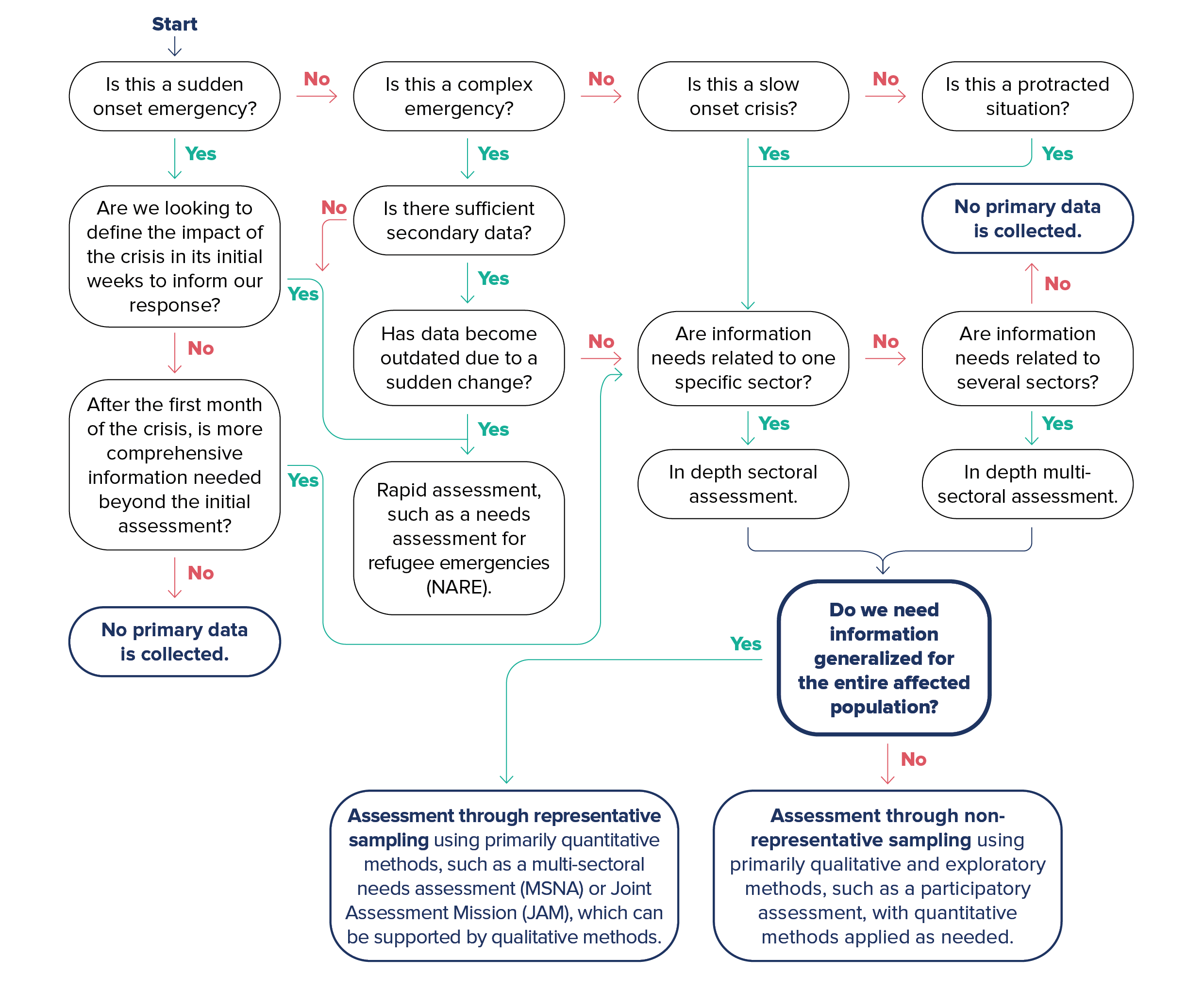
💡 KEEP IN MIND When choosing an assessment type, the operation analyses the suitability and feasibility of the approach. It considers factors such as access to populations, existing data, resources, ongoing and planned assessment activities by other actors, and the importance of a do-no-harm approach and other protection and data responsibility considerations. For information on considerations when designing a needs assessment, see the UNHCR Needs Assessment Handbook. |
The following section provides an overview of the steps in designing and implementing an assessment.
Step 1: Understand the context
The first step in the assessment process is getting an initial understanding of the context. This is about understanding the situation enough to think about the objectives of the assessment, which issues should be prioritized, and which type of assessment is needed. Prioritizing information needs requires a shared understanding within the MFT and with partners of upcoming programmatic and policy decisions that the assessment will inform. This guides the setting of objectives, helps define the focus of the assessment, and lays the groundwork for the assessment design and secondary data review.
💡 KEEP IN MIND Understanding the context helps to determine the need for an assessment, as well as its type and scope. To design the assessment, it is important to know the basics of:
|
Step 2: Design the assessment
Ensuring the successful implementation of an assessment, as well as the effective and appropriate use of its findings, requires adequate planning with key stakeholders, including forcibly displaced and stateless people. Planned assessments are documented in the relevant section of the assessment, monitoring and evaluation (AME) workplan during the annual implementation planning, to which additional ad-hoc assessments can be added during the year as necessary. For more information on the workplan see PLAN – Section 6.
The steps in the design phase are the following:

Set the objectives
The MFT and key stakeholders set clear objectives for the assessment by reviewing decision-making needs, and other information needs. These objectives inform the purpose, type, coverage, and methodology of the assessment, including its geographical scope, population groups to be covered, and the topics to prioritize. This clarity of purpose guides the analysis process, including the type of analysis, and reporting. Inputs from other stakeholders, including forcibly displaced and stateless people, are integrated to ensure the assessment considers their objectives and knowledge of the situation.
See guidance on the setting of assessment objectives.
Determine the coordination arrangements
Guided by the objectives, the MFT outlines roles and coordination approaches, both internally and with partners. This covers responsibilities for undertaking different steps of the assessment, including developing the assessment methodology and tools, logistics, budget, data management (notably the secondary data review, primary data collection, and analysis) and the preparation of the product that presents the findings (e.g., the assessment report). See resources on coordination.
For all assessments, the operation consults with relevant stakeholders to explore the possibility of a joint assessment and avoid duplication.
Define and prioritize the information needs
The MFT defines and prioritizes the assessment’s specific information needs based on its objectives. This process determines the data required for the analysis. Thematic cross-cutting issues (e.g., livelihoods, security, environment, protection risks, and resilience) and gaps in the response are identified, supporting data-driven intervention strategies.
Information needs are structured by defining an analytical framework or adapting an existing one. An analytical framework is a common method used for organizing and classifying what information is needed and is available. It describes the relationships, interactions, causes and effects between the elements to be measured in the assessment, and guides the analysis.
An analytical framework for an assessment is guided by its objectives and can be informed by the situation analysis framework, and other analytical frameworks, tools, and guidance. A common analytical framework for an assessment ensures an agreement and understanding between the actors involved about the purpose, scope and expected outcomes. One such example is the UNHCR-WFP Joint Analytical Framework (JAF), to better understand the ability of forcibly displaced and stateless people to meet their basic needs. This global framework can be adapted to different contexts by country operations.
After defining the analytical framework, the MFT develops a data analysis plan to guide the collation or collection of data for each topic in the framework. The data analysis plan identifies indicators and data sources and is created before reviewing existing data or collecting new data. See examples and templates of a data analysis plan.
Design the data and information management for the assessment
To effectively manage the data gathered for the purposes of the assessment, the MFT sets up a clear workflow and timelines, including methods, processes, and tools for data collation, collection, storage, cleaning, quality assurance, analysis, sharing, dissemination, and use.
When designing the data management component of the assessment, colleagues ensure that personal data will be processed in compliance with UNHCR’s personal data protection and privacy framework, as outlined in UNHCR’s General Policy on Personal Data Protection and Privacy and the Policy on Protection of Personal Data of Persons of Concern to UNHCR. When outsourcing the assessment, it is crucial to evaluate if the potential vendor meets data protection and information security standards. For more information on the data protection and information security capacity of funded partners, see PLAN – Section 8.
⚠️ ALERT The financial requirements for an assessment are included in the resource management plan, whether undertaken directly by UNHCR or through funded partners. |
Step 3: Collect and collate the data
Types of data gathered for an assessment
If reliable and up-to-date information is available, including from prior assessments, an assessment can use only secondary data. However, if the secondary data review concludes that there is a gap between the information needed and the information available, the operation decides whether primary data collection is necessary and feasible, considering factors such as the below.
| Primary data collection recommended | Primary data collection not recommended |
|
|
Effective use of quantitative and qualitative data
Both primary and secondary data gathered for an assessment can be qualitative, quantitative or a mix of both.
Using both quantitative and qualitative data allows for a more comprehensive understanding of the humanitarian situation and needs, and supports evidence-informed decision-making:
- Quantitative data, which is numerical, provides a measurable way to understand the humanitarian situation. It can be easily stored in a database and analysed using statistical and other methods to identify patterns, trends, and relationships between variables.
- Qualitative data, which is non-numerical information such as perceptions, personal experiences, attitudes and intentions, provides valuable insights for understanding a situation and interpreting quantitative data. In country operations, qualitative data is particularly useful to help understand how a situation affects different age, gender, and diversity groups, analyse the cultural and social context, and identify sensitive issues and topics.
Both quantitative and qualitative data can be used to establish baseline information and monitor changes over time.
Methods and tools to gather data for an assessment
Different humanitarian crises and contexts require different assessment methods and tools. When designing primary data collection methods and tools, the operation considers the units of measurement, which determine the level of analysis. The four units are: community-level, institution-level, household-level, and individual-level assessments.
There are different types of data collection methods, including direct observation, focus group discussions, key informant interviews, and household or individual surveys.
The MFT chooses the most suitable and feasible methods based on the type of assessment, the information needs, and available resources. Mixed methods can be used to ensure a comprehensive understanding of the situation (see Outlining the Methodology).
Sampling approaches in assessments
Sampling is the process of selecting a subset of units from a population for study. Due to efficiencies in time and resources, most assessments require sampling.
Probability and non-probability sampling are two principles of selecting units for a study. The choice of sampling method depends on the assessment’s objectives, time and resource constraints, and the availability (or lack) of sampling frames, i.e., lists from which to sample.
- Probability sampling assumes that each unit within a population has a known nonzero probability of being selected for the study. This approach is used when the objective is to generalize the findings to the entire population.
- Non-probability sampling is a principle of convenience sampling that does not rely on the probabilities of selection, and some population units have no chance at all to be selected. Instead, judgement is used to select units that are easily accessible, or that are assumed to represent the target population’s diversity. Non-probability sampling is commonly used in qualitative research and in cases where inferences to the population are less important. Findings from non-probability sampling are not statistically representative of the broader population, and results cannot be generalized.
It is important to carefully consider the advantages (e.g., reliability of findings, accuracy of sampling error estimation) and disadvantages (e.g., risks, costs) of each sampling method before selecting one for a given assessment.
Additional information on the types of probability and non-probability sampling methods can be found in the UNHCR Assessment and Monitoring Resource Centre.
Step 4: Undertake analysis, data storage, and cleaning
After gathering secondary and/or primary data, the data is organized and stored securely, ensuring it is well-documented and easily accessible for the analysis phase. The raw, clean, and anonymized data from the assessment is securely stored on the UNHCR Raw Internal Data Library (RIDL), where it can be accessed and reused by UNHCR personnel. The data collected for the assessment is securely stored and maintained along with its metadata so that authorized users can access and retrieve it.
For both qualitative and quantitative data, data cleaning is conducted by detecting and (potentially) correcting corrupt, inaccurate or inconsistent values from a dataset, improving the reliability of the data. Actions undertaken to clean and organize the data should be documented, (see Checking and Cleaning Data).
Conduct joint analysis and generate findings
Once the data is organized and cleaned, analysis is undertaken, guided by the information needs that were established based on the assessment’s objectives. The results of assessments are disaggregated and analysed by age, gender, and diversity as contextually appropriate and possible, to see how responses vary across groups.
Joint data analysis is a collaborative process involving the MFT, partners and stakeholders with different expertise working together and using an agreed methodology to turn the data and information into actionable findings — key insights drawn from patterns and trends in the data that support the objectives of the assessment. It is guided by the information needs that were established based on the assessment’s objectives.
This approach can promote a more accurate understanding of the data, foster buy-in for the findings, enable joint decisions and shared responsibilities, as well as mitigate misunderstandings and conflicting views. These findings help identify the core issues and gaps that need to be addressed, forming the basis for the recommendations. Clear, well-documented findings are essential to inform decision-making and meet assessment objectives.
Even if the assessment is not joint, involving key partners and stakeholders in the analysis promotes shared understanding and complementary actions. Where possible, forcibly displaced and stateless people are involved in the analysis.
💡 TIP Workshops are an effective way to engage partners in a joint analysis process, notably to share information that helps contextualize the data. However, they may be time-consuming and resource-heavy and require facilitation skills and methodological rigor to ensure that the multitude of voices are heard and considered in an effective and meaningful way. See joint analysis for more information. |
Develop action-oriented recommendations
To enable UNHCR and stakeholders to act upon the findings of the joint analysis process, action- and response-oriented recommendations are developed. The recommendations are informed by the assessment objectives. These recommendations are developed collectively, based on discussions between the MFT and other stakeholders involved. Combining workshops with bilateral follow-up discussions can prove useful, especially when a subset of findings and recommendations are relevant to specific stakeholders.
The assessment recommendations are formulated to be as feasible, concrete and tangible as possible to ensure that they are acted upon. They include details about who should take action and on which timeline. Once the recommendations are agreed upon, it is important to explain in the assessment report that the findings and recommendations reflect a consensus of the actors involved, noting major differing opinions where relevant. For more information, see Developing Assessment Recommendations.
Step 5: Share the assessment information
Documenting and sharing the findings, conclusions, and recommendations that emerged from the joint analysis process is critical to informing decision-making and avoiding inefficient programming or duplicated efforts. This can be done in a report or other type of information product, including through feedback consultations with communities.
It is important to disseminate the findings of an assessment on time and in a concise product that is structured to assist with the decisions and actions associated with the objectives of the assessment.
The MFT decides the best way to share assessment information and findings with forcibly displaced and stateless people, ensuring it is accessible and culturally appropriate.
Developing and implementing a dissemination plan helps ensure that the assessment report reaches key stakeholders. Timely dissemination of assessment results in a concise report aids decision-making. The report should clearly state findings, recommendations, methodology, and limitations (see the dissemination plan template).
The report clearly states findings and recommendations, along with information about the methodology and its limitations. When designing the report and selecting the target audience(s) and channel(s) for its dissemination, it is important to ensure that it does not contain sensitive information, particularly if it will be made public. This is the case for both UNHCR and interagency reports. For example, it may be useful to have a detailed internal version of the report and prepare a shorter external version that will provide evidence to other actors, informing them about the results without creating protection risks or otherwise causing harm to the people or organizations involved in the assessment.
In all cases, personal data is excluded from public reports, and internal access to this type of data is regulated on a need-to-know basis with due consideration to the legitimate purposes of its processing. For example, access to personal data can be granted for case management activities that are undertaken as a result of the assessment.
In addition to disseminating the assessment findings, anonymized datasets can be made publicly available through the UNHCR Microdata Library (MDL) to ensure wider access to non-sensitive data and enable its reuse.