

OVERVIEW
UNHCR’s mandate and vision
“Our vision is a world where every person forced to flee can build a better future.”
UNHCR is mandated to provide international protection and humanitarian assistance, and to seek durable solutions for forcibly displaced and stateless people. UNHCR’s original core mandate covered only refugees, however, over time this has been expanded to cover returnees and stateless people. Although UNHCR does not have a general mandate for internally displaced people, it may be involved under certain circumstances to enhance protection and provide humanitarian assistance.
UNHCR’s mandate and structure was set forth in its Statute, adopted by the UN General Assembly in 1950, which also provides the criteria under which persons may come within the competence of UNHCR.
UNHCR’s mandate was subsequently extended by the Convention relating to the Status of Refugees and by various resolutions of the UN General Assembly and the Economic and Social Council (ECOSOC).
In its external communications, UNHCR encapsulates its work as follows:
UNHCR leads international action to protect people forced to flee conflict and persecution and those denied a nationality.
Strategic Directions
In 2022, the High Commissioner set out five Strategic Directions to chart a five-year path forward for UNHCR. These Strategic Directions commit UNHCR to:
- Protect, secure, and defend the rights of people of concern to UNHCR – refugees and asylum-seekers, returnees, internally displaced people, and stateless persons (hereafter referred to as forcibly displaced and stateless people).
- Respond rapidly and effectively in emergencies and beyond.
- Promote inclusion and self-reliance.
- Empower the people we serve to determine and build their futures.
- Pursue solutions to address the consequences of displacement and problems of statelessness.
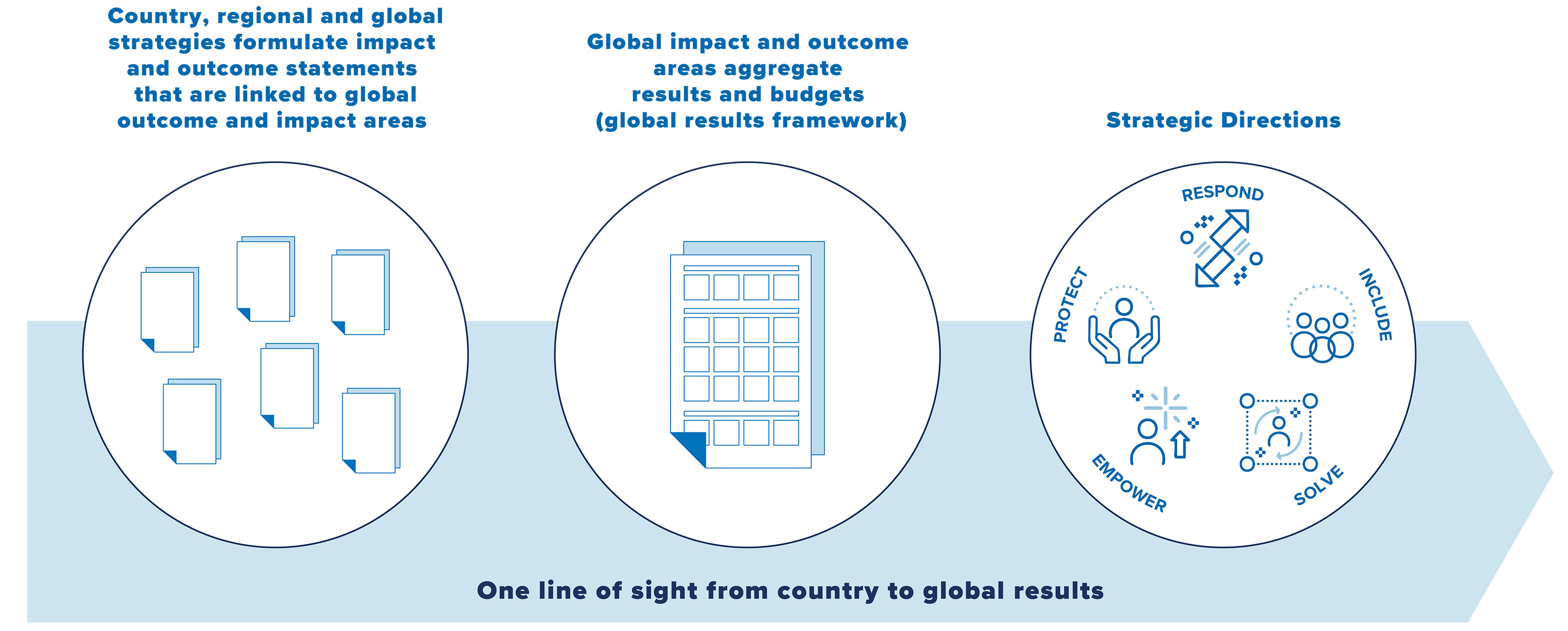
The Strategic Directions run through our global, regional, and country strategies and drive our practical efforts on the ground. This progression – the flow of strategy into action – is built into UNHCR’s approach for planning for, getting and showing results. The Strategic Directions and UNHCR’s global results framework and, ultimately, all UNHCR’s multi-year strategies are clearly linked: the strategies contextualize the Strategic Directions and the global results framework translates the Strategic Directions into impact and outcome areas, expressing the global changes we seek for forcibly displaced and stateless people and our contribution to these changes.
💡 KEEP IN MIND UNHCR has introduced two inter-related priorities – the sustainable response and route-based approaches in 2024. They represent greater specificity and focus for UNHCR’s catalytic and operational role in different countries, in accordance with UNHCR’s mandate. They also require UNHCR to work with the state and local authorities to leverage more systematically the support of other actors towards protection and solutions results for forcibly displaced and stateless people, building on the GCR and GRF pledges. |
The sustainable response approach seeks to address protection risks by empowering affected communities until durable solutions are found. This approach aims to maximize self-reliance and access to basic rights through greater and faster inclusion of forcibly displaced and stateless people in the communities that host them, earlier and more predictable development assistance in hosting areas, and enhanced whole-of-government leadership. Investing in sustainable responses supports the implementation and systematization of the Global Compact on Refugees..
The route-based approach ensures better protection in the context of mixed and onward movements of refugees and migrants. There are significant challenges for governments in countries of origin, asylum transit and destination to provide asylum, protection and assistance to mixed movements of refugees, migrants and others in need of protection. To address these challenges, UNHCR and IOM have developed the route-based approach, a framework to support states and communities along key routes in upholding rights, providing services and creating opportunities for asylum seekers, persons seeking protection and migrants, to prevent their need for onward movement..
Focus areas
The UNHCR Strategic Directions identify eight focus areas that the organization has prioritized for greater acceleration and more targeted action:
- Safeguard international protection, including in the context of mixed movements.
- Strengthen accountability to the people we work with and for, especially women and children.
- Reinforce efforts to strengthen gender-based violence prevention, risk mitigation and response.
- Expand on, pursue and adapt options for resettlement and complementary pathways.
- Mainstream development engagement in our responses from the outset, especially by building coalitions with development partners.
- Grow our engagement on responses and solutions for internally displaced people.
- Redouble efforts on statelessness so that the objectives of the #IBelong campaign are best pursued.
- Proactively act to mitigate the effects of the climate change crisis on displacement and in line with our protection mandate.
The focus area strategic plans provide direction and guidance in the implementation of the focus areas and offer an explanation of how UNHCR plans to work differently. They are implemented through UNHCR’s multi-year strategies, with operations retaining full autonomy in deciding how to implement them.
Below is a summary of key shifts and focus countries in the focus area strategic plans:
| Focus Area | What is this plan about | Relevant for |
| Accountability to affected people (upcoming) | The plan clarifies UNHCR’s accountability to affected people in all that we do, and UNHCR’s support to government capacity to do the same as UNHCR transitions to inclusion. | Relevant to all operations. |
| Gender-based violence (upcoming) | The plan recommends strengthening inclusion from the onset and safe transition of GBV services to national authorities. It commits UNHCR to a renewed focus on investing in women-led organizations for sustainability. | Relevant to all operations. |
| Engaging Development Actors | The plan focuses on minimizing aid dependency and clarifying the parameters of our relationship with development actors. | Particularly relevant to low- and middle-income countries. |
| IDP response and solutions | The plan sets out a global blueprint for prioritizing UNHCR’s work in situations of internal displacement, based on the context, presence, and capacity of other actors and IASC members. It provides specific guidance on government engagement, investment in communities, including those at risk of displacement, and sustainable responses. | Relevant to all IDP operations. |
| Ending Statelessness | The plan pinpoints priority actions for ending and preventing statelessness and protecting stateless people, including through partnerships with development actors and UN organizations. The plan identifies 27 priority countries where UNHCR will focus on (a) stepping up efforts to advocate for and support the government to grant nationality to in situ stateless people, (b) engaging deeper with the UN Resident Coordinator, UNCT and development actors to prevent statelessness, or (c) improving the identification, enjoyment of rights and setting up a pathway to nationality for stateless migrants and refugees that lack protection. | Relevant to all countries with stateless populations, and the 27 priority countries. |
| Climate action | The plan clarifies UNHCR’s role when climate change impacts the protection of people forced to flee. It outlines our asks to development and climate actors for inclusion and investment in sustainable national systems. The plan identifies 22 priority countries where UNHCR will either (a) focus on leveraging the inclusion of displaced and stateless people in others’ climate adaptation and resilience programmes; and/or (b) deliver humanitarian action to immediately support climate resilience and adaptation; and/or (c) implement multi-year climate projects in sectors/programming areas where UNHCR leads, through tapping into climate/development financing. | 22 priority countries. |
UNHCR’s results architecture
UNHCR differentiates between three levels of results (impacts, outcomes and outputs). They
are the basis for the results framework at the country, regional and global levels. This approach is in line with the UN results-based management structure.
UNHCRs results architecture includes:
- A global results framework that aggregates, analyses, and presents results and resources globally.
- A context-specific results framework that each operation defines in collaboration with partners. Every context-specific results framework is linked to the global results framework through the relevant global result areas (impact and outcome) to allow for the global aggregation of results and resources.
UNHCR’s global results framework
The global results framework aims to:
- Provide an organizational framework for planning, budgeting, monitoring, and reporting that can be applied to all contexts and types of interventions.
- Consolidate country results and budgets into a cohesive global picture and enable coherent monitoring and reporting on the global results over time.
- Create a direct link between country strategies and UNHCR’s Strategic Directions. Country operations link their strategies to the global results areas which in turn are fully aligned with the Strategic Directions.
- Align actions around key areas of UNHCR’s mandate and global commitments for forcibly displaced and stateless people.
- Describe UNHCR’s contribution to the achievement of the Global Compact on Refugees (GCR) and the Sustainable Development Goals (SDGs).
- Operationalize the vision of a human rights approach as a driver for all results.
UNHCR’s global results framework comprises four impact areas, 16 outcome areas and five enabling areas, representing UNHCR’s mandate, the UNHCR Strategic Directions 2022-2026 and areas of work. There are no global output areas because outputs are context-specific deliverables.
The global results framework includes a set of core impact, outcome and output indicators that measure UNHCR’s contribution to the changes in the lives of forcibly displaced and stateless people across countries, allowing for the global presentation of results. Core indicators are UNHCR’s prioritized set of results data that are used internally and externally for telling a story of change at the country and global levels.
For more information, see the UNHCR Global Results Areas and the Sustainable Development Goals and the Global Compact on Refugees.
Global impact areas – Protect, Respond, Empower and Solve
UNHCR’s four global impact areas represent the changes in the lives of the forcibly displaced and stateless people that UNHCR seeks to contribute to, together with other stakeholders. They link directly to the four Strategic Directions of Protect, Respond, Empower and Solve. The fifth area, Include, cuts across all four impact areas and outcome areas.
Impact Area 1 – Attaining favourable protection environments (PROTECT)
This covers the intended changes in the enjoyment of rights for forcibly displaced and stateless people as a result of increasingly favourable protection conditions, including due to changes in law and policy in areas such as access to asylum, registration, status determination, documentation, human rights, and provision of international protection.
Changes can include preventing deterioration.
Impact Area 2 – Achieving basic rights in safe environments (RESPOND)
This covers intended changes in the well-being of forcibly displaced and stateless people due to shifts in access, quality, and coverage of basic services, particularly in humanitarian and emergency settings irrespective of whether these needs are met through humanitarian assistance, inclusion into national service delivery or other means.
Impact Area 3 – Empowering communities and achieving gender equality (EMPOWER)
This covers intended changes in protection and solutions for forcibly displaced and stateless people as a result of community empowerment, strengthened gender equality and increased livelihood opportunities.
Impact Area 4 – Securing solutions (SOLVE)
This covers intended changes in the enjoyment of durable and alternative solutions for forcibly and stateless people, including resettlement, voluntary return, naturalization, local integration, relocation for internally displaced people and complementary pathways.
Sixteen global outcome areas
The 16 outcome areas represent UNHCR’s key areas of work towards the achievement of rights for forcibly displaced and stateless people. They are linked to the 2030 Agenda for Sustainable Development and the related Sustainable Development Goals (SDGs), which are aspirational long-term goals with the potential to transform the well-being of forcibly displaced and stateless people.
Five global enabling areas
UNHCR’s global results framework includes five enabling areas which encapsulate UNHCR’s management work such as fundraising, supply, oversight, human resource management, policy development, support to governance bodies, information technology, operational support, learning and financial management. Enabling Area 21 is reserved for the organizational executive leadership and oversight function at the headquarters level.
UNHCR Strategic Directions 2022-2026 and the global results framework

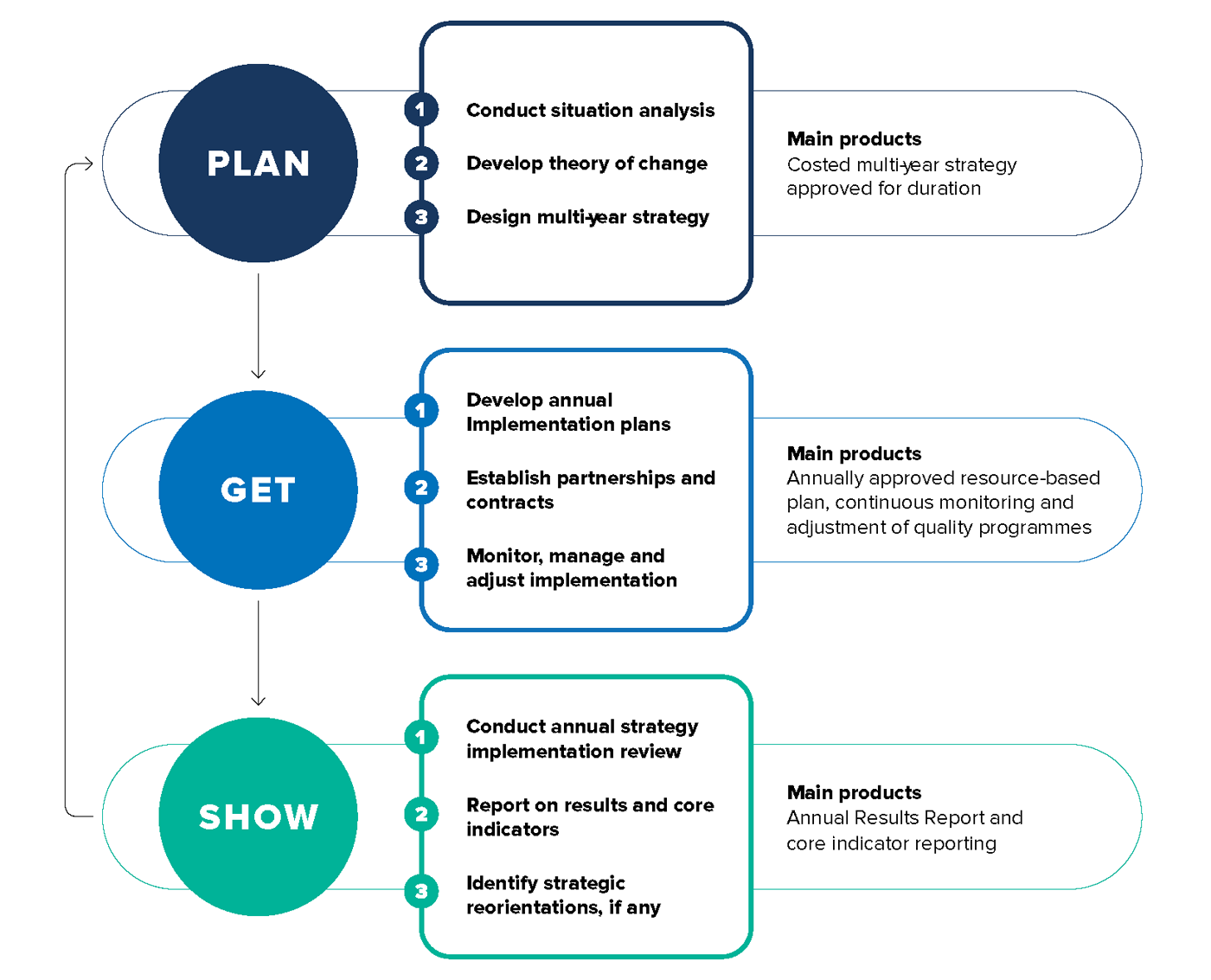
UNHCR employs a results-based management (RBM) approach in its multi-year strategy planning and programming called COMPASS. This approach aims to enhance UNHCR's effectiveness and capacity in delivering protection and solutions for forcibly displaced and stateless people and report on its results. It defines how UNHCR operations plan for, show and get results over a multi-year period. COMPASS is intricately linked to the global results framework.
UNHCR’s multi-year strategy/programme cycle comprises three phases:
a) PLAN for Results is the first phase and takes place between January and April of each year. In this phase, operations prepare context-specific multi-year strategies. They articulate changes in the protection and solutions for forcibly displaced and stateless people and define what UNHCR intends to be engaged in and deliver in collaboration with partners. They align with relevant development and humanitarian planning.
b) GET Results is the second phase and takes place annually during a multi-year strategy. It operationalizes the strategic vision set forth in the multi-year strategy. In this phase, operations prioritize resource-efficient actions to transform strategies into tangible implementation deliverables, aligned with UNHCR's budget based on needs. An important part of the GET phase is the collaboration with partners for the delivery of programmes. UNHCR uses the Project, Reporting, Oversight and Monitoring Solution (PROMS) to work with funded partners.
c) SHOW Results is the third and last phase, interconnecting with the preceding PLAN for and GET Results phases. It takes place between January and April of each year in parallel to the PLAN for Results phase. In this phase, operations undertake an annual implementation review through the Strategic Moment of Reflection (SMR), analysing progress, understanding achievements and lessons learned, identifying areas for reprioritization or adjustments and finalizing the Annual Results Reports (ARRs). UNHCR’s Global Report and other external reporting are based on the Annual Results Reports.
The three phases of UNHCR's multi-year strategy
💡 KEEP IN MIND In all phases of the programming cycle, considerations are given for diverse age, gender and diversity (AGD) groups, including children, women, men, older persons, persons with disabilities, LGBTQIA+ people and indigenous people. |
The programme cycle is a collective effort realized by the contribution of colleagues across different functions based on the UNHCR’s roles, responsibilities and authorities (RRAs) and grounded in the decentralization.
The multi-functional team (MFT) is a group of colleagues from two or more functional areas, working together to solve a problem that requires capabilities, knowledge and expertise not available from a single source. It brings together individuals with different skills and perspectives to analyse the rotection environment and to design and deliver a response that is more complete and age-, gender- and diversity-sensitive. Other stakeholders such as forcibly displaced and stateless people, non-governmental organizations, UN organizations, government, and development partners, host communities and donors are also included, as appropriate. The MFT does not call for a fixed structure and is seen as a flexible approach, with expert participation dependent on the specific matter at hand. The MFT approach is applied at each stage of the programme cycle and requires strong leadership especially from directors and representatives and from its members.
The plan owner (representative, bureau director or head of entity), who is accountable for the development, implementation, and review of the entire multi-year strategic plan of the country or bureau.
The plan approver (bureau director or SET member), who has the authority to endorse the multi-year strategic plan of the country, bureau or headquarters division or entity under their supervision.
The planning coordinator, who orchestrates the planning process, including the development of the situation analysis, population planning figures, priorities, theory of change, results framework, monitoring and evaluation plan, budget, and positions.
The planning coordinator is nominated by the plan owner within each operation, bureau, division or entity. They guide the MFT to produce a coherent strategy within established time, policy, and budgetary parameters. They also coordinate the overall implementation planning and monitoring of the strategy, as well as reporting on results. They play a leading role in conducting and compiling the situation analysis. They also advise the representative or the director on quality assurance and resource allocation.
While the planning coordinator has the overall role of facilitating and coordinating implementation planning. The results managers and resource preparers are expected to work together with the rest of the multi-functional team, drawing on their technical skills and knowledge, to identify the best way of achieving results, adjust and detail the outputs and indicators and OL positions, detailed administrative and operations budgets.
The results manager, who, as part of the MFT, is accountable for developing part of the multi-year strategy pertinent to their area of work, including the results framework, population planning figures and OP budget and positions. They represent the technical expertise required for each results area in an operation’s multi-year strategy, including protection. They are responsible for developing results statements and the related monitoring approach, monitoring their results area with funded partners, communities and other stakeholders as appropriate, interpreting results data, and reporting on results.
Staff representing diverse functions – technical specialists (including for example, protection, education or health), information management, programme, senior management and others – can assume the role of results managers depending on the operational context, as well as the size and structure of the operation.
Operations may assign one results manager per core outcome area, although a results manager can be accountable for more than one outcome area alone or more than one results manager can be accountable for one outcome area. The plan owner decides on the number of results managers for their operation. Results managers aim to strengthen the results culture whereby various functions within the MFT share ownership and accountability in all phases of managing results.
The resource preparer, who is preparing and managing OP/OL budgets at the strategic planning and implementation phase.
The quality assurer (bureau/headquarters), who provides quality assurance feedback on multi-year strategies as well as annual results reports of operations prior to their approval.