

PLAN - Section 3: Situation Analysis
Overview
A situation analysis is the first step in developing a new multi-year strategy. It is the basis for the vision, strategic priorities, and theory of change and for forging strategic partnerships and fostering greater stakeholder collaboration. The situation analysis assesses the country’s context and the protection and solutions situation for forcibly displaced and stateless people, as well as the host community. It has four components: the contextual analysis, the population planning figures, the protection and solutions analysis and the planning scenario.
In a nutshell
- For this analysis, operations use existing quantitative and qualitative data, including information from interagency or national data systems. They also utilize inter-agency or agency-specific multisectoral and sectoral assessments as well as qualitative participatory assessments. If new data collection is needed, operations examine the need for such data and potential gaps in existing data.
- The population planning figures (PPFs) capture the estimated number and characteristics of populations for the coming years and are central to defining the planning scenario.
- The protection and solutions analysis assesses the legal and policy framework and the realization of the rights of forcibly displaced and stateless people. It identifies their unmet needs and opportunities for solutions, forming the basis for setting strategic priorities in the next step of the PLAN for Results phase.
- The planning scenario includes the key assumptions that underpin the strategy, which are refined in later steps.
Country operations conduct a situation analysis as the first step in developing a new multi-year strategy. The situation analysis assesses the country’s context and the protection and solutions situation for forcibly displaced and stateless people, as well as the host community. It includes four components: the contextual analysis, the population planning figures, the protection and solutions analysis and the planning scenario. All operations use the situation analysis to create a planning scenario and establish the operation’s vision, strategic priorities, and theory of change. Bureaux and headquarters divisions and entities only develop a context analysis that describes the situation in their region or thematic area.
UNHCR has a catalytic and supportive role with mandated responsibilities, as outlined in its Statute, the 1951 Convention, Executive Committee Resolutions, the Global Compact on Refugees, UN General Assembly Resolutions and the IASC Cluster System (for IDPs).
When possible and relevant, operations ensure that their situation analysis is coherent with and informed by the joint and inter-sector analysis conducted for inter-agency plans such as Humanitarian Response Plans (HRPs), Refugee Response Plans (RRPs) and the Common Country Assessment (CCA). UNHCR’s situation analysis can also be a source of information for analytical inter-agency processes and deliverables.
A country operation prepares a situation analysis when starting the development of a new multi-year strategy and updates it annually by April for the subsequent years covered by the strategy (see PLAN – Section 2).
💡 KEEP IN MIND The situation analysis and the assessments are interlinked. The situation analysis is developed and updated as part of the PLAN for Results phase using existing data and information from a variety of sources, including assessments. Assessments can be conducted throughout the programming cycle. Their findings can be used to inform the situation analysis as well as other processes such as results monitoring. |
Four components of situation analysis
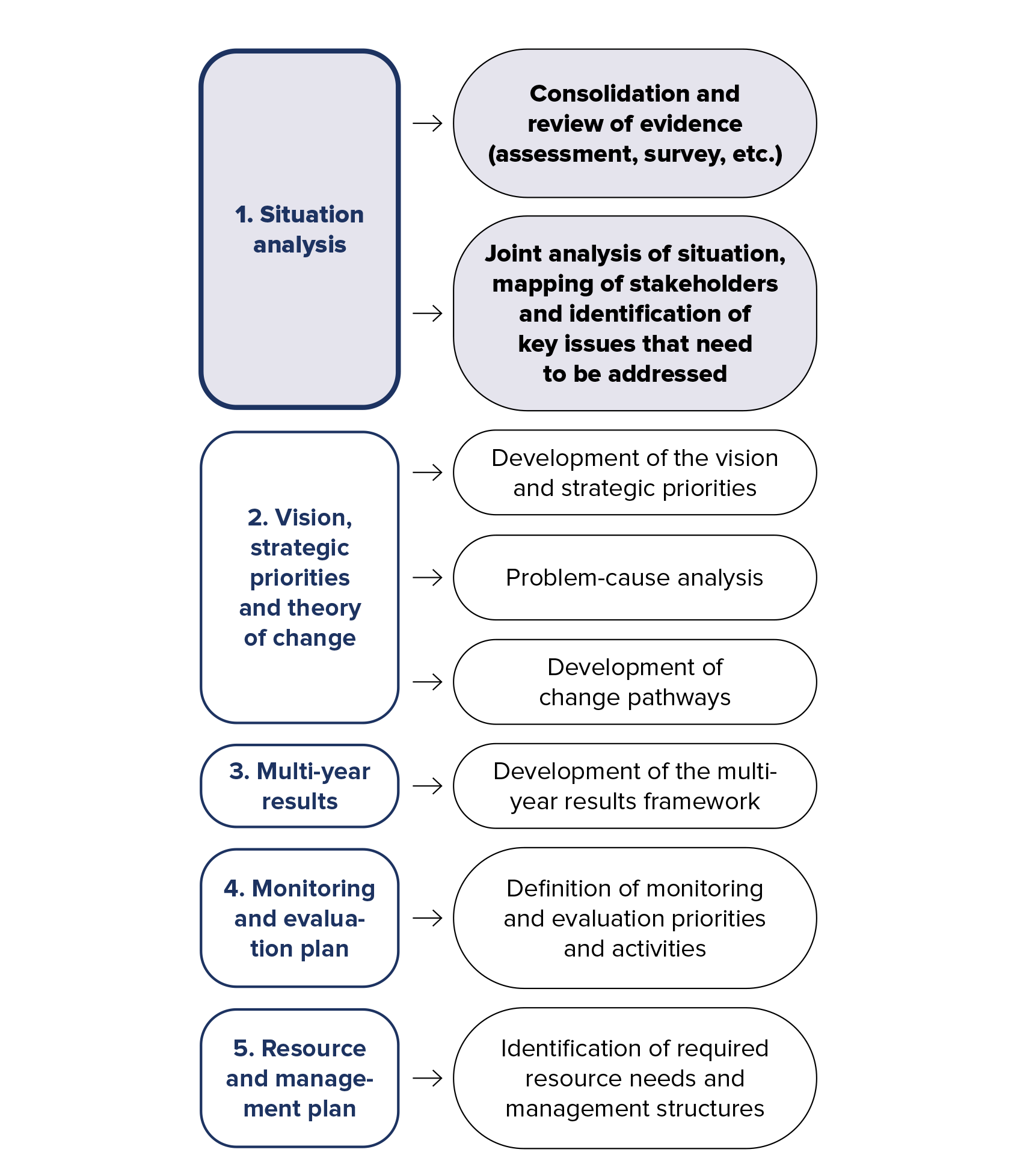
A strong situation analysis:
- Is relevant and timely in addressing key issues, e.g., the legal, socio-economic, and displacement situation, based on the context.
- Is unbiased, neutral and impartial.
- Systematically identifies and collates all relevant information.
- Is based on an analytical framework that provides a structured approach to gathering and interpreting data, guiding UNHCR personnel and partners in decision-making.
- Assesses the quality and credibility of the data.
- Is transparent about data limitations and in predicting future evolutions.
- Distinguishes facts, assumptions and judgements.
- Uses clear, evidence-based reasoning.
- Uses structured techniques to mitigate biases in conclusions.
💡 TIPS
|
The key guiding questions for context analysis are:
- What is the current socio-economic, security, and institutional context affecting forcibly displaced and stateless people in the country?
- How is this context affecting the rights, protection, and opportunities for solutions for forcibly displaced and stateless people?
- What are the key characteristics and trends of forcibly displaced and stateless people and the local communities, including age, gender, other aspects of diversity, countries of origin, ethnicity, professions, education, and socio-economic profiles?
Through the context analysis, operations gain a thorough understanding of the country context and how this influences the protection risks, the enjoyment of rights, and the opportunities for resilience and solutions for forcibly displaced and stateless people. See below for more information on the protection and solutions analysis.
The context analysis examines a country’s macro-level context, focusing on general trends in political and institutional arrangements, and socio-cultural, economic, technological, security and environmental factors.
The analysis also includes types of forcibly displaced and stateless people, population movements, displacement or return patterns, statelessness and their effects on the environment, governance, infrastructure, services and social cohesion. Operations may also analyse causes of displacement and the situations of countries or places of origin and consider factors influencing the operational environment for delivering protection and solutions such as national labour cost and logistics.
The analysis then considers how these factors influence the overall protection environment and the situation of forcibly displaced and stateless people, as well as how the presence of forcibly displaced people impacts governance, infrastructure, services, and the environment. This analysis also looks at the opportunities and challenges of implementing the Global Compact on Refugees and pledges made at the Global Refugee Forum.
Operations use data collected through assessments, including needs and participatory assessments, and feedback received from the communities, as well as various internal surveys and studies. Operations also conduct legal analysis with tools like UNHCR’s Rights Information Mapping and Analysis Tool (RIMAP) and consider the gender and power analysis (see PLAN – Section 1).
A significant part of the secondary data for the context analysis is available through external sources, including publicly available country information from authorities (e.g., legislation, socio-demographic data and other statistical data of the country), international financial institutions (e.g., the World Bank and regional banks) or major think tanks and external surveys. Other secondary sources of information may also be inter-agency analytical documents such as the Common Country Assessment (CCA), part of the United Nations Sustainable Development Cooperation Framework (UNSDCF).
Operations review the available information to ensure that it is relevant and reliable, using UNHCR’s protection and solutions expertise. This process also incorporates an understanding of the country’s situation, including through the lens of regional dynamics. The multi-functional team (MFT) participates in this review, including the prioritization of information.
Operations also need to articulate the roles of UNHCR and other key stakeholders (key agents of change) and identify their sphere of influence. This analysis can use existing mapping of local, national and UN actors.
💡 KEEP IN MIND Operationalizing sustainable responses: Operations ask a set of sub-questions for implementing sustainable response and route-based approaches:
|
Stakeholder mapping
Stakeholder mapping is a crucial part of situation analysis. It helps operations identify key actors who influence the situation of forcibly displaced and stateless people and can drive necessary changes to improve protection and facilitate solutions. Operations build on this mapping when formulating the theory of change and further analyse which stakeholders can influence desired changes (see PLAN – Section 4).
This mapping is a collaborative exercise conducted by the MFT. It aims to identify the key stakeholders and their power, capacity, interest and degree of engagement in the protection and solutions for forcibly displaced and stateless people. This process informs decisions on engaging priority stakeholders and is the first step towards defining UNHCR’s engagement strategy for advocacy and partnerships.
The key question to ask is:
❓ Who are the main stakeholders, and what are their interests, power, leverage and capacity to influence the provision of protection and solutions for forcibly displaced and stateless people?
The stakeholder mapping can start early in the strategy development process and be refined as the strategic priorities become clear. It should also be updated throughout the duration of the multi-year strategy to capture changes in the operational context and stakeholder landscape.
The stakeholder mapping involves identifying:
- Current and potential stakeholders.
- Forcibly displaced and stateless communities, including groups within them of different age, gender and other aspects of diversity.
- Government entities at national or sub-national level, including different line ministries and other state institutions.
- Civil society organizations (e.g., women, youth, persons with disabilities, LGBTIQ+) and organizations led by people with lived experience of forced displacement and statelessness.
- Academic and research institutions.
- Private sector
- Financial institutions.
- Stakeholders from the human rights, peace, humanitarian and development spheres.
- Donors.
When mapping stakeholders, operations can use existing information as a starting point, such as “the 3Ws” (who does what and where) for inter-agency coordination or the UN Partner Portal (UNPP). It is important to go beyond existing partnerships and identify stakeholders that are not traditionally linked to UNHCR’s work, including development partners. Visualization tools like the sphere of influence can help assess a stakeholder’s power and interests.
💡 KEEP IN MIND
|
In the multi-year strategy, the population planning figures (PPFs) capture the yearly estimated number of forcibly displaced and stateless people in each country and their characteristics including sex, age and other aspects of their displacement situation. These figures are central for defining the planning scenario and may later require further analysis (see below for more information on the planning scenario). At the global level, PPFs are key references in UNHCR’s programme and budgetary submission to the Executive Committee (ExCom) and are of interest to UNHCR’s government counterparts, donors and other stakeholders. They also help define population coverage for each results statement in the multi-year result framework (See PLAN – Section 5).
All country operations define their PPFs. In countries included in multi-country offices, the PPFs should be set for each country with a multi-year results framework. If a country does not have its own multi-year result framework, setting PPFs is optional. Bureaux and headquarters divisions and entities do not include PPFs in their strategy.
The key questions to define the PPFs are:
❓ Who are the forcibly displaced and stateless people, returnees, host communities and others of concern with whom UNHCR needs to engage?
❓ How many are currently in the country, and how many are expected to be present there over the multi-year plan period?
❓ How many of those people does UNHCR intend to assist over the multi-year strategy period?
The country operation defines the population types that are present in the country using the following types:
- Refugees and asylum-seekers: Refugees, asylum-seekers, persons in refugee-like situations, and others in need of international protection under the UNHCR Annual Statistical Reports (ASR).
- Stateless people.
- Internally displaced people (IDPs): IDPs and persons in IDP-like situations under the Annual Statistical Report (ASR).
- Returnees: This includes refugee returnees and IDP returnees under the ASR.
- Host communities: Communities hosting displaced and stateless people.
- Others of concern.
For each population type, the country operation defines:
a. The estimated total number of individuals that UNHCR expects to be in the country at the end of each planning year, except for returnees where the total number during the year is calculated. These figures are adjusted by the operation during the strategy implementation to align with operational needs and are known as "population affected" in the inter-agency context.
b. The total number of individuals that UNHCR aims to assist by the end of each planning year for the strategy period. This includes forcibly displaced and stateless people who benefit from one or more UNHCR programmes. Operations count people that are expected to directly or indirectly benefit from individual/household assistance or community-based interventions, using the following three-level approach:
i. Assistance to individuals/households.
ii. Assistance to communities.
iii. Capacity-building and advocacy type of activities.
This figure is known as the “population in need” in the inter-agency context.
People who only indirectly benefit from the results of capacity-building activities with governments and other authorities, as well as advocacy-type activities, should not be included in the UNHCR-assisted figures, even though these activities might impact all forcibly displaced and stateless people in a country.
When inserting the population planning figures into COMPASS, the operation also lists the three major countries of origin for the relevant population types. All other countries of origin are combined into the field marked “various”.
Population Planning Figures by Population Type
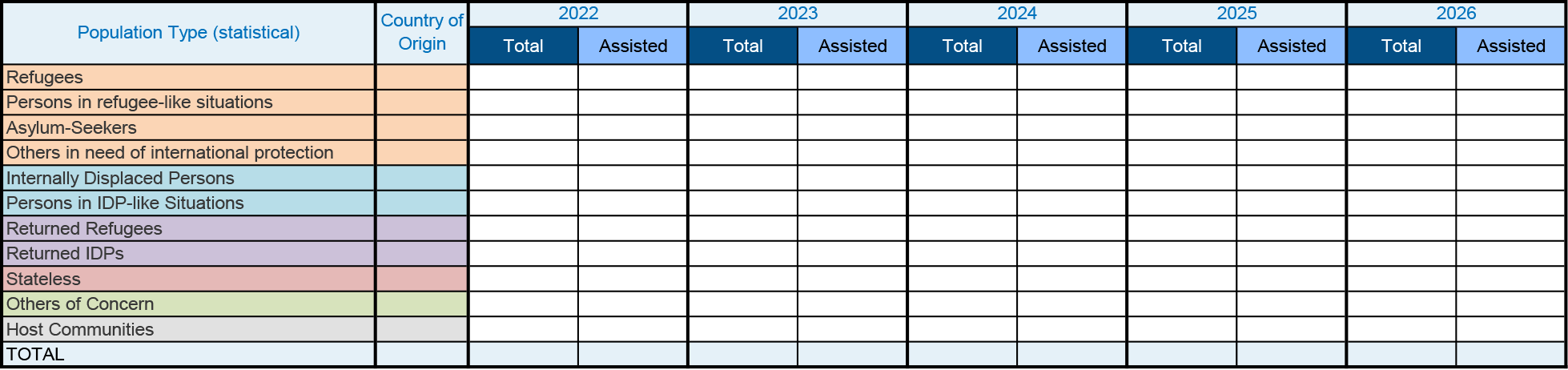
In a country where UNHCR provides specific support for return, reintegration, naturalization and resettlement (third country solutions), the operation can further define these populations in the specific planning figures (SPFs) within COMPASS. The SPFs provide information on the subsets of populations such as the expected number of voluntary repatriations, resettlement departures or arrivals, and naturalizations.
Operations can use the trends from the current and previous ASRs, the Mid-Year Statistical Reports (MYSR) and the population data in the UNHCR Orion platform as initial reference data for formulating the PPFs. This approach ensures that the forecasted population numbers and profiles for the coming years align with the past and current ASRs.
The operation then predicts the likely progression of each population type, considering demographic factors and overall assumptions about the evolution of the context. This includes changes in movement patterns into, out of, or within the country, and the availability of solutions such as local integration, voluntary repatriation, or resettlement starting from a specific future date. The Global Data Service’s predictions on refugee and asylum-seeker numbers by country can be used as input. This analysis leads to discussions on a planning scenario for the strategy.
Operations carefully monitor the consistency of the PPFs throughout the strategy's duration. The operation makes sure that any changes in the PPFs are coherent with possible changes to the operations plan (OP) budgets.
💡 TIP
|
💡 KEEP IN MIND The UNHCR ASR and the MYSR provide biannual statistical snapshots of the numbers and characteristics of forcibly displaced and stateless populations (see SHOW – Section 2). These country reports are compiled globally and published as the Global Trends report, which is UNHCR’s flagship report and is part of the UN’s official statistics. |
The protection and solutions analysis assesses the extent to which the rights and needs of forcibly displaced and stateless people are being fulfilled in each context. It uses a range of protection information channels to examine the current situation and likely future developments, focusing on risks, opportunities, and challenges related to age, gender, disability and other relevant aspects of diversity.
The process of defining the population planning figures captures not only the total number of forcibly displaced and stateless people, but also key information such as age, gender, location, origin, ethnicity, disability, and other relevant aspects of diversity.
The protection and solutions analysis starts with the summary of the population analysis, answering the following question:
❓ What are the key characteristics and trends in the profile of forcibly displaced and stateless people and the communities that host them, including their age, gender, other aspects of diversity, countries or places of origin, ethnicity, professions, education and socio-economic profiles?
The country operation analyses protection and solutions for all relevant population groups considering the contextual and stakeholder analysis so that they can pinpoint the key issues that UNHCR must address and thus determine their strategic priorities. In analysing protection and solutions opportunities, gaps and challenges, country operations are guided by the following questions:
❓ What is the legal and socio-economic environment for the various population groups with and for whom UNHCR works?
❓ What are the main protection risks and obstacles in realizing basic rights that forcibly displaced and stateless people face in the country?
❓ What are the most relevant unmet needs, challenges and opportunities in the enjoyment of rights and solutions for the various population groups with and for whom UNHCR works?
By answering these questions, the country operations can identify the areas that need to be prioritized by UNHCR in their operation’s strategic priorities.
The four impact areas of UNHCR’s global results framework provide a basis for the protection and solutions analysis, supporting the development of the strategy. Operations also refer to impact, outcome and output indicators, as some of these can serve as data sources to inform the protection and solutions analysis.
❓ What are the protection and solutions needs, gaps and opportunities for forcibly displaced and stateless people?
💡 KEEP IN MIND Operations analyse the different profiles of people UNHCR works with and for, applying the Age, Gender and Diversity lens. Operations may ask the following questions for implementing sustainable response and route-based approaches.
|
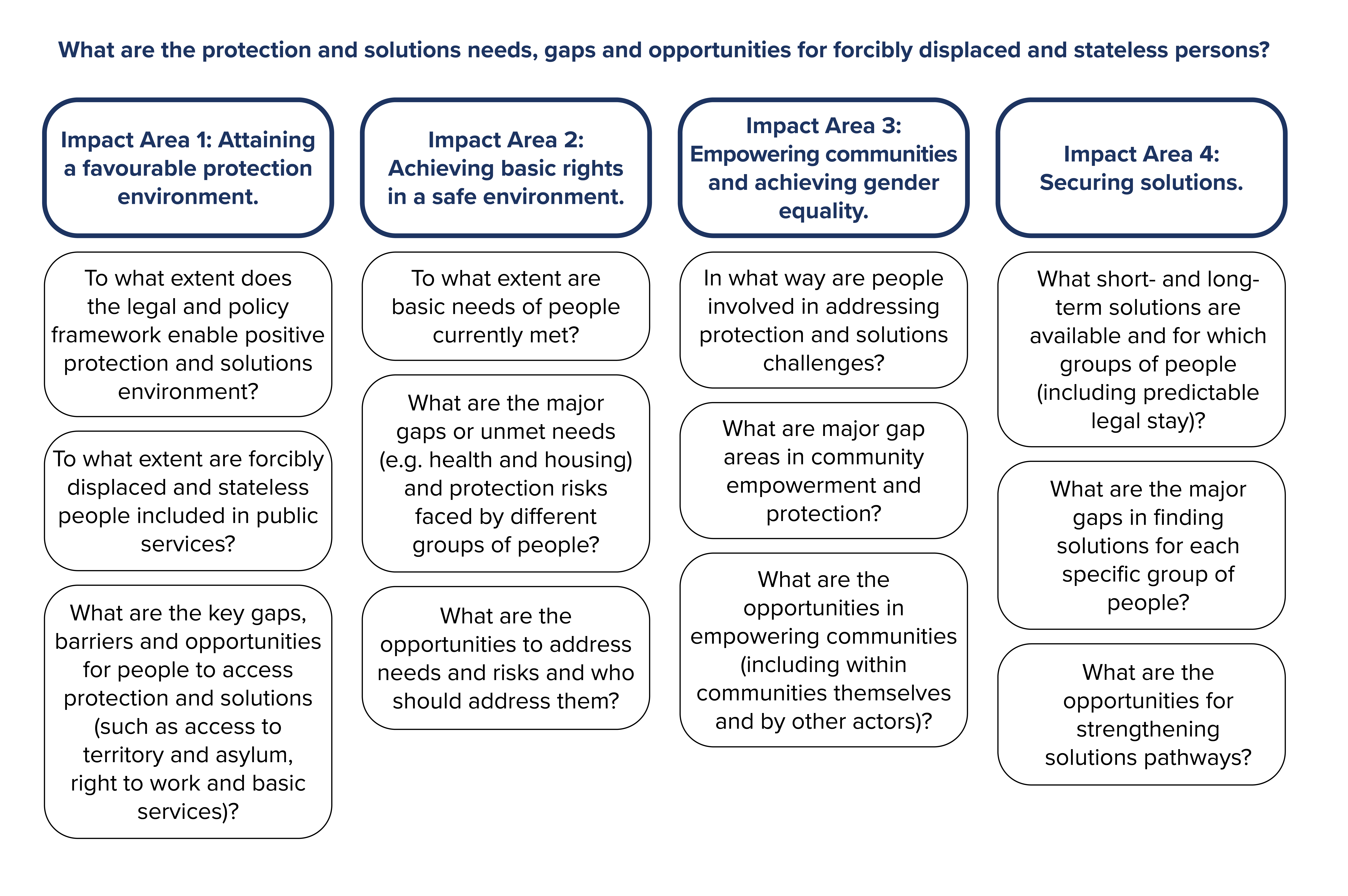
When analysing the protection and solutions situation, operations reflect on the lessons learned in the past strategy. They can use the findings from the analysis of impact and outcome indicators data, which was produced for the Strategic Moment of Reflection (see SHOW – Section 1) and the Annual Result Report (see SHOW – Section 2) to substantiate their conclusions. By tracking and analysing changes over time with core impact and outcome indicators, as well as other relevant context-specific indicators defined or used by the country operations (user-defined indicators or indicators from others), they gain insights into the protection and solutions opportunities and challenges for forcibly displaced and stateless people (see PLAN – Section 5 for how to configure core impact indicators). Operations can also use the Draft SitAn Analytical Framework for their analysis.
💡 KEEP IN MIND After gathering the relevant data and information on the context and the protection and solutions situation, operations bring together the multi-functional team and, where relevant, external actors to conduct a joint synthesis and analysis. This helps develop a shared understanding of the main factors influencing the context, needs, gaps, and opportunities related to protection and solutions. This understanding, along with population planning figures, serves as the foundation for creating a planning scenario. |
Joint synthesis an analysis: guiding questions
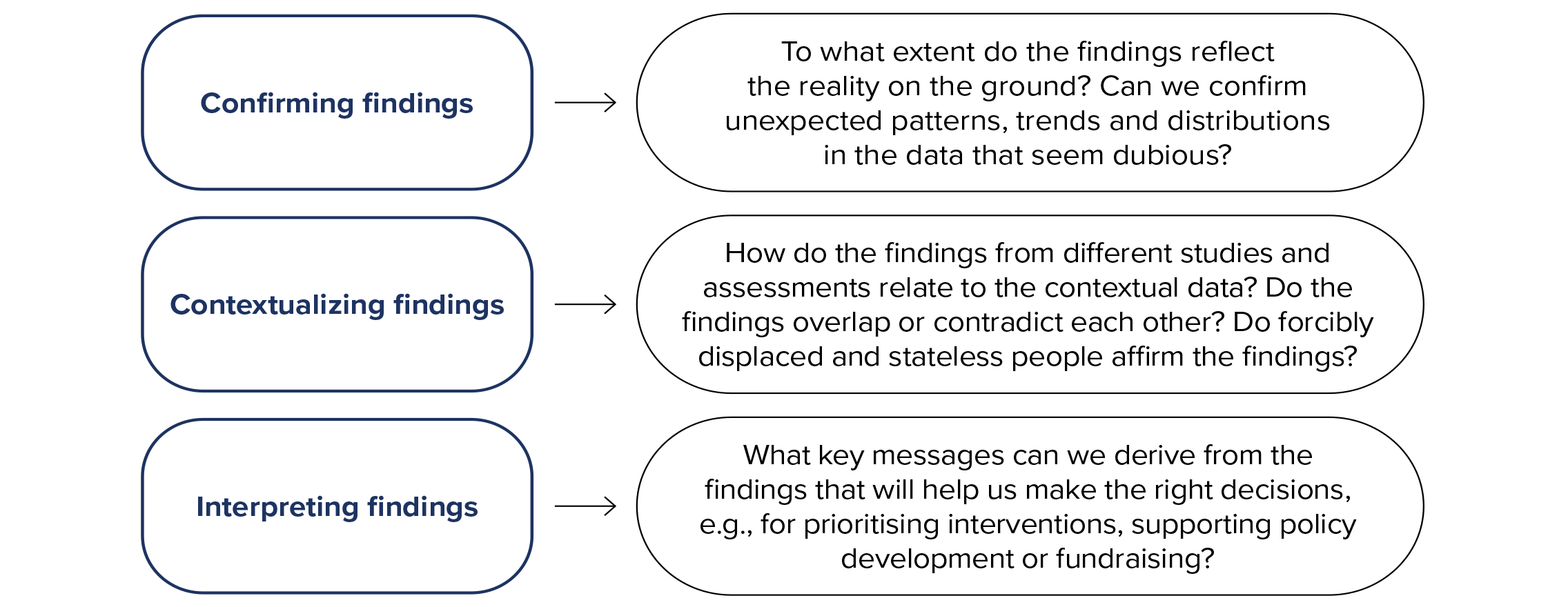
For the types of analysis, see the UNHCR Assessment and Monitoring Resource Centre.
Each multi-year strategy has a planning scenario, which defines the main assumptions underpinning the strategy. It documents the expected evolution in the country context, the legal and policy environment, population trends, and the presence and engagement of stakeholders over the strategy’s duration. This scenario is the basis of the multi-year strategy, including the planning of resources for the whole duration of the strategy.
When planning, operations must systematically identify possible future developments of the situation by analysing and assessing potential opportunities and risks that could impact the overall situation as well as the evolution of the risks, needs and opportunities for solutions for forcibly displaced and stateless people. These developments may involve contextual and environmental events that could shape the operating context during the period of the multi-year strategy. Examples include the prospects of renewed or continued violence, or the cessation of hostilities in countries or places of origin, potential peace and political agreements, natural disasters, or other significant internal or external shocks that may drive population movement. Operations also identify opportunities for sustainable responses and route-based approaches.
Operations formulate the planning scenario at the end of the situation analysis process based on the findings of the contextual, stakeholder, and protection and solutions analysis. They may consider several scenarios and analyse the implications of diverse trends. At the end of the process, it is important that the operations agree on a single set of assumptions for the strategy, which will guide the development of the vision, strategic priorities and the theory of change.
Operations may consider the following questions when developing their scenario:
❓ What is the likely scenario for the country context, population movements and demographic changes of forcibly displaced and stateless people over the strategy period?
❓ What is the forecast for protection and solutions opportunities, including the protection environment in the country of asylum, the situation in the country or place of origin, and resettlement and complementary pathways?
❓ What are the assumptions about the changes in the role of stakeholders and UNHCR related to protection and solutions?
💡 KEEP IN MIND Operationalizing sustainable responses: Operations may ask these additional questions.
|